Most people who ask what a move costs mean the movers. That's one line of the budget. This guide gives you the movers' price for your size and distance, what makes it swing, and the rest of the cash a move needs before the last box is open.
What does it cost to move in 2026?
Two large data sets point to the same local number. HireAHelper, a marketplace for moving help, reports a typical full-service local move of $1,480 for a three-bedroom apartment or two-bedroom house, from the final prices customers paid. This Old House's 2025 survey of 1,000 people who hired full-service movers found local moves averaged $1,489, and $2,000 was the total people reported most often. Most moves are local: 72% of the people in that survey stayed within their state or finished in a day.
Long-distance numbers vary more, because distance and weight vary more. Here is HireAHelper's 2026 data for full-service movers, by home size:
| Home | Local (under 50 miles) | Long distance (1,200 miles) |
|---|---|---|
| One-bedroom or small two-bedroom apartment | $879 | $5,078 |
| Typical two-bedroom apartment | $1,158 | $5,666 |
| Three-bedroom apartment or two-bedroom house | $1,480 | $6,261 |
| Three-bedroom house | $1,625 | $6,729 |
| Four-bedroom house | $2,013 | $7,393 |
| Five-bedroom house | $2,300 | $7,975 |
This Old House's survey puts long-distance moves lower, averaging $3,129 and rising from $2,074 for 50 to 200 miles to $3,945 past 1,700 miles. Distance doesn't explain the gap: in its survey, a two-bedroom moved 1,101 to 1,400 miles averaged $2,668, against HireAHelper's $5,666 for full service. Plan from the HireAHelper table, which prices a full-service move, and treat the survey as the low end. Use the table for your size and distance, and treat both as a starting point, not a quote.
As a planning range, before you have quotes:
| Move | Movers to plan around | All-in cash to test |
|---|---|---|
| Studio or small local move | $500–$1,500 | $2,000–$5,000 |
| Two-bedroom local move | $900–$2,500 | $4,000–$8,000 |
| Two- to three-bedroom long-distance move | $3,500–$7,500 | $10,000–$18,000 |
| Larger or complex long-distance move | $6,000–$12,000+ | $18,000–$35,000+ |
The all-in column is the movers plus the cash the rest of this guide covers: rent and deposits, travel, supplies, setup and a buffer. These are our planning ranges, not quotes.
Why do local and long-distance moves cost so differently?
They're priced two different ways.
- Local moves are priced by the hour. You pay for the crew, the truck and the time, so stairs, an elevator, a long walk to the truck and how much you own matter more than the miles. HireAHelper puts a local full-service crew at $120 to $160 an hour for two movers and $160 to $200 for three.
- Long-distance moves are priced by weight and miles. The shipment's weight, the route, the delivery window and any storage on the way set the price. Interstate movers must survey your goods and give you a written estimate, by federal rule.
That's why the same home costs so different an amount on different routes. HireAHelper's 2026 prices for one 1,500-square-foot home, about a three-bedroom apartment:
| Route | Full-service movers | You drive the truck, pros load it |
|---|---|---|
| Dallas to Fort Worth | $1,487 | $578 |
| Los Angeles to San Diego | $1,815 | $723 |
| Chicago to Minneapolis | $3,699 | $1,172 |
| Phoenix to Denver | $4,723 | $1,855 |
| New York City to Los Angeles | $10,474 | $3,894 |
| Boston to Seattle | $11,348 | $4,228 |
How much does it save to do some of the work yourself?

A lot, and more the farther you go. For a typical two-bedroom apartment, in HireAHelper's 2026 data:
| How you move | Local | 1,200 miles |
|---|---|---|
| You drive a rental truck, hired help loads and unloads | $488 | $1,818 |
| A moving container, hired help loads and unloads | $916 | $3,036 |
| Full-service movers | $1,158 | $5,666 |
Our arithmetic: across 1,200 miles, the truck saves about $3,848 over full service, and the container about $2,630. Across town the truck saves about $670.
What the savings cost you is time, effort and risk:
"At first glance, a DIY move seems cheaper since you rent a truck, ask friends to help, and think you've saved money."
Aikman's point is the extras: rental insurance, mileage charges and days of packing. A real-estate executive put the trade-off plainly:
"For longer-distance or complex moves, professional movers may actually be more cost-effective and far less stressful in the long run."
And a Missouri State University instructor named the real question:
"The biggest question is not one of out-of-pocket money, it's time and physical capability."
If you drive yourself, add what the truck rate leaves out: fuel, a hotel or two on a long drive, meals on the road, and the days off work.
What do you pay besides the movers?

Usually more than the movers on a short move, and often more again on a long one. moveBuddha's guide to hidden moving costs, updated November 2026, puts typical prices on the lines people forget:
| Cost | Typical price |
|---|---|
| Security deposit on a rental | One month's rent |
| Utility deposits | $100–$500 |
| Utility hookup and transfer fees | $50–$300 |
| Boxes, tape and packing supplies (two to three bedrooms) | $100–$350+ |
| Move-out or move-in cleaning | $100–$400 a cleaning |
| Parking permit for the truck | $20–$150 a permit |
| Stairs, elevator, long carry or shuttle fees | $75–$500+ |
| Storage between homes | $50–$300 a month |
| Groceries and essentials for the first month | $150–$400 |
| Fuel, tolls, lodging and meals on the way | $50–$500+ |
The first month's rent, if you're renting, comes on top. On a $2,200 apartment, the rent and a one-month deposit are $4,400 due at signing, before a mover has lifted anything.
Here is one full budget: a two-bedroom apartment moving from Denver to Portland, about 1,250 miles, with full-service movers and packing. The plan prices it as three rooms, so it opens at 3 bedrooms: the living room counts as the third. Set it to your own home.
| Line item | Planning amount |
|---|---|
| Professional movers | $4,200 |
| Packing service | $1,350 |
| Tips for movers | $150 |
| Movers, packing and tips | $5,700 |
| First month's rent | $2,200 |
| Security deposit | $2,500 |
| Boxes and packing supplies | $360 |
| Move-out cleaning | $750 |
| Utility setup and deposits | $250 |
| Travel to the new city | $600 |
| Food during move week | $450 |
| Renter's insurance | $200 |
| Disposal and donation hauling | $200 |
| New-place basics | $300 |
| Address-change and small fees | $60 |
| Planning buffer | $2,430 |
| Total cash for the move | $16,000 |
The deposit and the cleaning sit above the typical ranges on purpose: a plan should cover a landlord who asks for more than a month, or a deep clean of the place you leave.
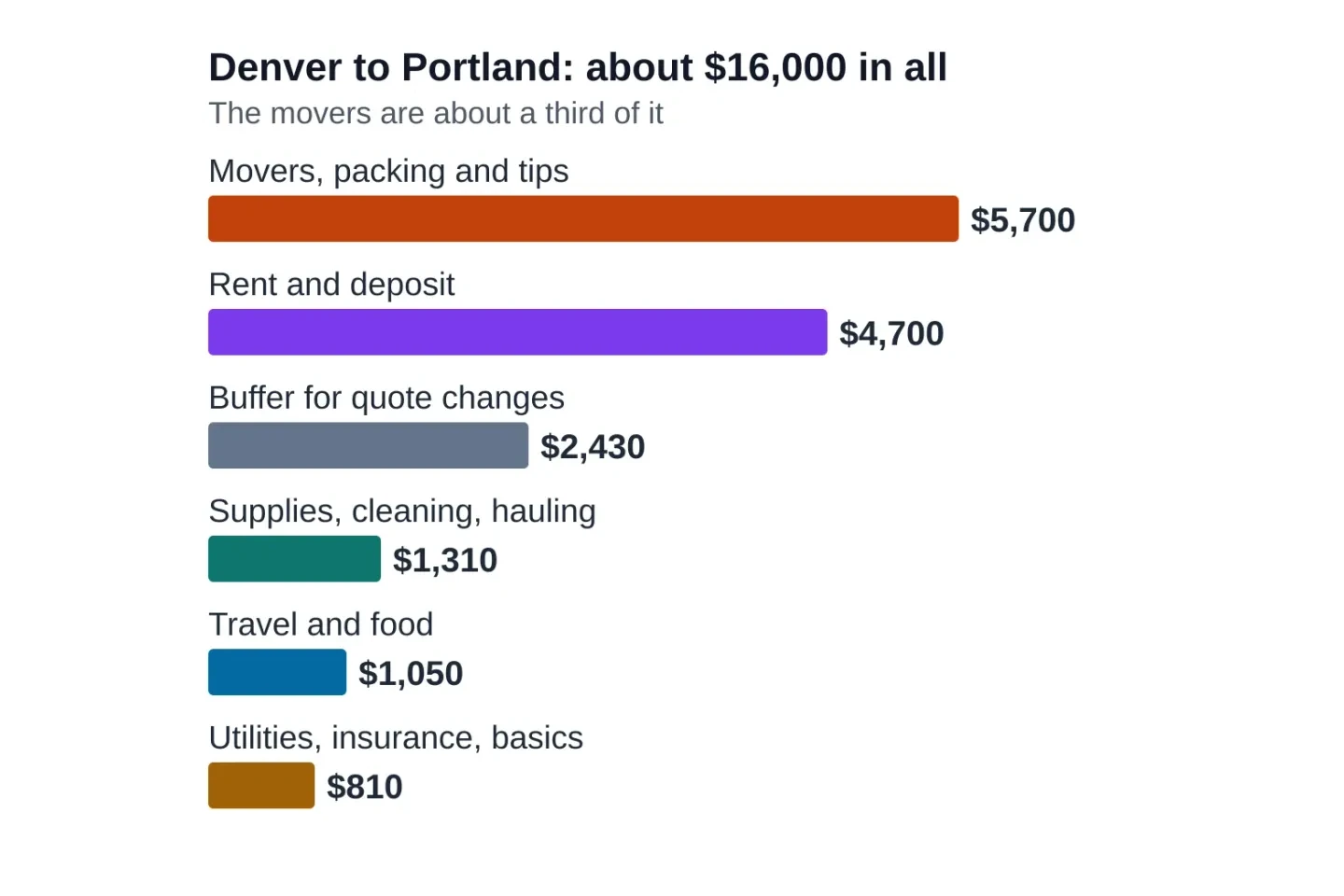
Without the tips, the movers and packing come to $5,550, close to HireAHelper's $5,666 for a typical two-bedroom apartment over 1,200 miles. The rest is everything else the move needs. When the plan opens, it groups the same lines its own way (packing sits under Boxes and packing, the deposit and rent under Deposits and first payments), so its subtotals differ from the chart's while the lines and the $16,000 total match. Not every two-bedroom move costs $16,000; the point is to put the mover's quote and the full cash plan side by side.
Open the prefilled Denver-to-Portland move budget to start from these lines, then change the distance, rooms and rent to yours.


Budget 1/2
Budget · in the planner
The Moving Planner, shown on its Local 2BR example, counts the deposits and first month's rent beside the movers and boxes, and marks each line quoted, booked or paid.
See how it worksWhen is the cheapest time to move?
Midweek, mid-month, and outside summer. Summer weekends and the first and last days of the month are when most leases turn over, so crews book up and prices rise.
"Try to move during the off-season or on a weekday—peak times like weekends or the beginning of the month can be much more expensive."
Book four to eight weeks ahead if you can; last-minute moves cost more because there's less choice. If your lease end is fixed, move the date you control, the pickup, to a weekday.
What if the price goes up on moving day?

That depends on the estimate you signed. For an interstate move, the mover must give you a written estimate and say whether it's binding. In This Old House's 2025 survey, only 43% of people said they were offered a binding one; about 11% paid more than they were quoted, most often $200 to $1,000 more.
Here is what each kind means at the door, on a $4,200 estimate:
| Estimate | Most you pay at delivery | If the load weighs less |
|---|---|---|
| Binding | $4,200, plus services you added after signing | You still pay $4,200 |
| Non-binding | $4,620 (110%), plus services you added | You pay less |
| Binding not-to-exceed | $4,200, plus services you added | You pay less |
On a non-binding estimate, anything over 110% isn't forgiven: the mover bills it to you after delivery instead of collecting it at the door.
The table is our arithmetic on the federal rules. On top of each, the mover may charge for "impracticable operations" in its tariff, such as a shuttle truck when the big truck can't reach the door, up to 15% of the other charges at delivery. Ask which of those your building might trigger before you sign.
These rules cover moves between states. A move within one state falls under that state's rules, so ask the mover in writing what happens if the time runs over.
When you compare quotes, put each into the same lines: packing, stairs, shuttle, storage, valuation and the delivery window. The cheapest quote is often the one that leaves something out.
What if something breaks?
Check the valuation line before you sign, because the default pays very little. Federal rules make the mover liable for the full replacement value of what it loses or damages, up to the shipment's declared value, unless you waive that in writing. The cheaper option you can sign for, released value, pays about 60 cents a pound per item:
| Damaged item | Weight | Released value pays |
|---|---|---|
| A 55-inch TV | 30 lb | $18 |
| A dresser | 100 lb | $60 |
| A table lamp | 5 lb | $3 |
Our arithmetic at 60 cents a pound. More than half the people who made a long-distance move in This Old House's survey paid for full-value protection. If you own a few valuable, light things (a laptop, art, jewelry), carry them yourself.
What if your move-out and move-in dates don't line up?
Then you pay twice for somewhere to live, or for somewhere to keep your things. Price both:
- Overlap the leases. One extra month of rent, often the bigger number, but you move once and on your own schedule.
- Store between homes. $50 to $300 a month for the unit, plus a second load and unload. Some movers store your shipment in their warehouse between pickup and delivery, which saves the second move; ask for that price in the quote.
- Stay somewhere short-term. A hotel or a short-term rental while your things wait, plus meals out.
How much should you tip movers?
A common guide is $4 to $5 an hour per mover, This Old House says, or $20 to $60 per mover for the day, says moveBuddha. Three movers for six hours at $5 an hour is $90. Put it in the budget, and bring cash, so it isn't a surprise on the day.
Can you deduct moving costs or get them paid for?
Most people can't deduct them. The federal deduction for moving expenses is only for active-duty members of the Armed Forces moving on military orders, and, from 2026, employees and new appointees of the intelligence community moving for an assignment, the IRS says.
If your employer pays for the move, the money counts as taxable wages. The One Big Beautiful Bill Act of 2025 permanently ended the tax-free treatment of moving reimbursements except for those same two groups. So if a relocation package says $10,000, ask whether it's grossed up for tax; otherwise plan on getting less than that after withholding.
Which move is yours?
Find your situation, then start from that budget:
| Your move | Movers to plan around | What else to price first |
|---|---|---|
| A studio across town, friends help | A truck for the day, a few hundred dollars | Deposit and first month's rent, supplies, pizza |
| A two-bedroom across town, full service | About $1,200, HireAHelper's typical figure | Deposit and rent, parking permit, stairs or elevator fee |
| A two-bedroom 1,200 miles away, you drive | About $1,800 for the truck and loaders | Fuel, a hotel night or two, time off work |
| The same, in a container | About $3,000 | Where the container can park at both ends |
| The same, full service | About $5,700; ask whether packing is in it | A binding or not-to-exceed estimate, valuation |
| A four-bedroom house cross-country | $7,000 to $11,000+ (our range) | Storage if the dates don't line up, a second truck |
| Dates don't line up | Add $50–$300 a month for storage | Or a month of overlapping rent |
| A move your employer is paying for | Whatever the package covers | The tax on it |
How do you build a moving budget?
In this order, because each step changes the next:
- Choose how you'll move. Truck, container or full service changes the biggest line by thousands of dollars on a long move.
- Get three written estimates, in person or by video, and put each into the same lines. Ask for binding or not-to-exceed.
- Add the new place. First month's rent, deposit, utilities and insurance, due when you sign.
- Add the move itself. Supplies, cleaning, tips, parking, travel and food.
- Add a buffer of 10% to 15% of the total until the quotes are firm. In the example, the buffer is $2,430: about 18% on top of the other $13,570, or 15% of the $16,000 total.
Your next step
Write down three numbers today: your move date, the miles between the two front doors, and the rent and deposit you'll owe when you sign. Then:
- Open the prefilled Denver-to-Portland move budget and change the distance, rooms and rent to yours.
- Look at the Local 2BR example if your move is across town: it puts a mover's quote beside the cheaper truck-and-two-movers option.
- Ask three movers for written estimates, and put each one into the plan's ideas board side by side.
- Mark each line as you go: quoted, booked, paid.


Idea board 1/2
Idea board · in the planner
Keep each mover's quote, the truck option and a month of storage on one board, with its price and a note, and pass on the ones that don't add up.
See how it worksFor why the price formula changes with distance, see Local Move vs Long-Distance Move: Why the Cost Formula Changes.
This article is educational planning content, not a mover quote, tax advice or legal advice. Get written estimates from licensed movers before you sign.
Sources
- HireAHelper, Moving Cost Calculator: local, 1,200-mile, hourly and city-to-city prices from the HireAHelper Transportation Cost Database and Proprietary Transaction Data (2026); the $1,480 local median and the truck, container and full-service tables. Read 2026-11-16.
- HireAHelper, Moving Statistics and Trends 2026: local full-service move $1,480, labor-only $445.50.
- This Old House, Moving Costs (2026 Guide), updated June 12, 2026: 2025 survey of 1,000 people who hired full-service movers; local average $1,489, long-distance average $3,129, $2,000 the total reported most often, averages by distance, 72% local; tipping guide; the quotes from Marshall Aikman, Tam Marion Warren, David D. Hammons and Wade H. Abed.
- This Old House, Types of Moving Estimates, updated June 8, 2026: 43% offered a binding estimate; about 11% paid more than quoted, most often $200 to $1,000.
- This Old House, Cost To Move Out of State (2026), updated April 13, 2026: over half of long-distance movers bought full-value protection.
- moveBuddha, Unexpected Moving Costs, updated November 4, 2026: the hidden-cost price ranges and the $20–$60 tip guide.
- Code of Federal Regulations, 49 CFR 375.401 (written estimate, binding or non-binding), 375.403 (binding estimates), 375.405 (non-binding estimates), 375.407 (delivery on payment of up to 110%), 375.703 (the most a mover may collect at delivery, and the 15% limit for impracticable operations) and 375.201 (full-value liability unless waived in writing for the released rate).
- FMCSA, How can I avoid unexpected moving costs? and Consumer rights and responsibilities: binding, non-binding and binding not-to-exceed estimates.
- Surface Transportation Board, Released Rates of Motor Carrier Shipments of Household Goods: the 60-cents-a-pound released rate.
- IRS, Topic no. 455, Moving expenses for members of the Armed Forces and the Intelligence Community, updated October 16, 2026, and Publication 15-B (2026): who may deduct moving expenses, and the One Big Beautiful Bill Act's end of the reimbursement exclusion.
- The Denver-to-Portland budget, the planning ranges, the savings, the delivery-day, released-value and tip arithmetic are ours, on the stated assumptions. The Local 2BR figures are the Moving Planner's example as it opens. Every quote above was found word for word on the page cited.
More Moving Cost Calculator articles
Practical examples that connect the calculator to real planning decisions.