
More than half of U.S. adults (54%) took a group trip with people outside their household in the past five years, a June 2026 Harris Poll for CIT Bank found. Nearly half of them (45%) had a money conflict or discomfort along the way. This guide puts a number on each piece and shows who pays it.
How much does a group trip cost per person?
Here is a real plan: four friends, five nights in a U.S. city in February, each flying in from a different city, sharing a two-bedroom stay.
| Budget line | Group total | Who pays |
|---|---|---|
| Flights from four cities | $1,560 | Each person their own |
| Lodging, taxes and fees | $1,950 | Split four ways |
| Airport transfers and local rides | $420 | Split four ways |
| Meals and snacks ($75 a day each) | $1,800 | Each person their own |
| Shared activity | $440 | Split four ways |
| 10% buffer on lodging, rides, meals and the activity | $461 | Split four ways |
| Optional concert for two | $280 | Only the two who go |
That's $6,631 before the concert, about $1,658 a person on average. But nobody pays the average:
| Who | Flight | Total | A month, from 8 months out |
|---|---|---|---|
| Alex | $420 | $1,828 | $229 |
| Bri | $360 | $1,628 | $204 |
| Cam | $310 | $1,718 | $215 |
| Dev | $470 | $1,738 | $217 |
Each total is that person's flight, $818 of shared costs (the lodging, rides, activity and buffer, $3,271 split four ways) and $450 of meals, $75 a day for six days. Alex's and Cam's also include their $140 concert tickets. The last column is what each person saves a month if the group starts eight months before the trip. A single average would tell everyone "about $1,700". The split tells Alex to put away $229 a month and Bri $204, and it's the number each of them can actually plan around.
Open the prefilled four-friend trip budget to start from these flights, the stay, rides, meals, the activity, the concert and the buffer, then change them to your own quotes. The planner keeps the group's total and every line; the per-person split is the table above.
Why does the same trip cost twice as much in some cities?
Rooms and meals are where cities differ most. The federal government publishes what it will pay a traveler for a hotel room and a day's meals in each U.S. city, and the gap is wide. Here is our arithmetic for the same four friends at those rates: two hotel rooms for five nights, shared two to a room, plus six days of meals and incidentals each.
| Destination | Room a night, busy · quiet | Meals a day | A person, busy · quiet |
|---|---|---|---|
| Boston | $365 · $213 | $92 | $1,465 · $1,085 |
| New York City | $358 · $189 | $92 | $1,447 · $1,025 |
| San Francisco | $325 · $232 | $92 | $1,365 · $1,132 |
| Denver | $227 · $170 | $92 | $1,120 · $977 |
| Nashville | $230 | $86 | $1,091 |
| New Orleans | $188 · $138 | $80 | $950 · $825 |
| Austin | $184 | $80 | $940 |
| Orlando | $178 · $145 | $80 | $925 · $843 |
| Most smaller cities and towns | $113 | $68 | $691 |
The busy months: Boston September to October (quiet November to February), New York September to December (quiet January and February), San Francisco January to March (quiet April to August), Denver April to October, New Orleans February to May (quiet June to August), Orlando January to March. Nashville, Austin and the standard rate are the same all year.
Rates are GSA's for October 2026 to September 2027, before hotel taxes. They are what a government traveler is reimbursed, not what a vacation costs, so treat them as a floor: Las Vegas, for one, is left out because its federal rate is far below a Strip room with its resort fee.
Three things make the spread:
- The city. The same room is more than three times the price in Boston in October as in a standard-rate town. Meals vary less, from $68 to $92 a day.
- The month. New York's rate falls from $358 to $189 between the fall and January. Moving the trip can save more than choosing a cheaper hotel.
- The flight on top. The average domestic fare was $445 in the second quarter of 2026, in unadjusted dollars the highest quarterly fare the Bureau of Transportation Statistics has recorded; round trips averaged $549. Bag and seat fees are extra. The example's round trips, $310 to $470, are below that average, so put in your own quotes. A cheap city with expensive flights can cost more than the reverse.
Put those together and a room, meals and an average $445 fare come to about $1,140 a person in a standard-rate town and $1,910 in Boston in the fall, before any activities.
What does a bigger group save?

Less than people expect on the house, and more on everything one booking covers.
- The house. A house for ten costs more than a house for four, so lodging per person stays about the same as a group grows. Even the cleaning fee grows with the house: about $142 for a two-bedroom and $357 for a five-bedroom, AirDNA found in early 2025. That's $36 each for four friends and $36 each for ten. What lowers lodging per person is people sharing rooms, not more people.
- What one booking covers. A car, a private guide or a boat holds a fixed number of people, so its cost per person falls as the group fills it, then jumps when the group needs a second one.
- The bathrooms. Travelers say four people is the most who should share a full bathroom, Vrbo's 2026 survey of 2,000 renters found. A group of nine wants a house with three.
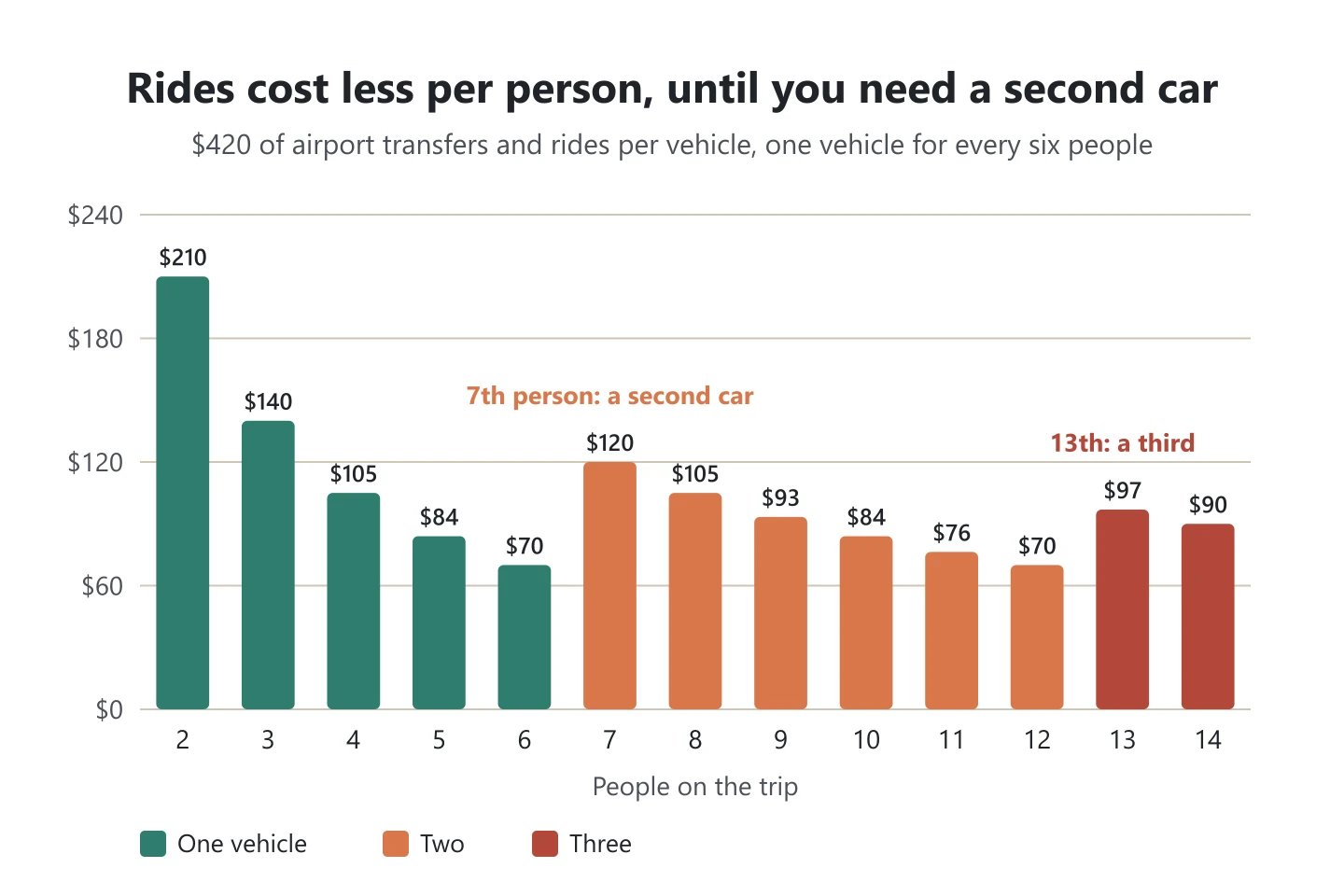
So when the group grows, check the steps before you celebrate the savings: a second car, a bigger house tier, a second table at dinner, a group rate that starts at ten. Adding the seventh friend can raise everyone's share of the rides.
How do you split a rental when the rooms aren't equal?

Pick the method before you book. The question that splits groups is whether a couple sharing the king suite pays the same as a friend alone in a bunk room.
"Splitting the cost of a big, beautiful vacation rental is smart, but everyone may not have the same definition of 'splitting',"
The same survey found the group divided: 44% said you should pay less if you share a room when others don't, and nearly two-thirds didn't mind sharing a bedroom as long as they had their own bed.
Here is one house, four ways. Seven friends rent a four-bedroom house for $3,500 for five nights. A couple takes the king suite with its own bathroom, a second couple a queen room, Casey has a queen room alone, and Dee and Eli share the bunk room.
Split by person, it's $500 each. The other three ways:
| Each person | By room | By bed | Weighted |
|---|---|---|---|
| King-suite couple | $438 | $350 | $583 |
| Queen-room couple | $438 | $350 | $486 |
| Casey | $875 | $700 | $583 |
| Bunk room, each | $438 | $700 | $389 |
Our arithmetic, rounded to the dollar; each column adds up to $3,500 before rounding. The weighted column counts shares: each person in the king suite with its own bathroom 1.2, Casey alone in a queen room 1.2, each person in the shared queen room 1.0, each bunk 0.8. That's 7.2 shares, so one share is $486.
- By person is the simplest, and renters in Vrbo's survey named splitting evenly as the most important piece of rental etiquette. It's fair when the rooms are close. It isn't when the rooms differ as much as these.
- By room makes anyone alone in a room pay double. Casey pays $875 for one bed.
- By bed rewards the couples, who share one, and charges the bunks as much as a queen.
- Weighted is the middle way when the rooms differ: nobody pays double, and the best rooms cost more. Agree the weights before anyone picks a room.

Every expense · in the planner
In the Split Expenses calculator, give each person a share of the house, leave someone out of the concert, and it works out who owes whom.
See how it worksWhat if one friend has a smaller budget?

Set the per-person ceiling where the tightest budget in the group can say yes, and set it before the house is booked. Then give everyone room to opt out of the expensive parts. Only 1 in 4 travelers told Experian their friend group sets a budget up front, and 61% of group travelers in the CIT Bank poll had overspent because of social pressure.
If you're the friend with the tighter budget, the advice is to get involved early:
"It's not fair to have your friends plan everything and then for you to complain that you can't afford it"
Kumok's alternative, if you can't help plan: give your friends your total budget and ask them to stick to it. And if the house itself is out of reach, Lizzie Post of the Emily Post Institute says there's no shame in staying elsewhere:
"If the cost of the rental property is outside what you feel comfortable spending, there's nothing wrong with finding your own accommodations."
Ways to bring the number down without leaving anyone out:
| Instead of | Try |
|---|---|
| A restaurant every night | Groceries for breakfast and one dinner in the house |
| One price for everything | A shared core (house, rides, one activity) plus opt-in extras |
| The best room for everyone | A bunk or shared room at a weighted share |
| Peak season | The same city in its quiet months (New York in January is about $420 less a person than in the fall) |
| Flying in for a long weekend | One more night, so the flight is spread over more of the trip |
Who pays when plans change?
These are the cases that end friendships. Decide them in the group chat before the deposit, and write the answer down.
| What happens | A fair default |
|---|---|
| Someone drops out after the house is booked | They pay their share of what's already booked, and the group tries to fill the spot |
| Someone arrives a day late or leaves early | They pay their full share of the house (it was booked for everyone) but skip that day's groceries and rides. Half of renters in Vrbo's survey thought they should pay less, so agree it first |
| One friend pays the deposit for everyone | Everyone pays them back by a set date, and it's written down with who owes what |
| Someone doesn't drink | Drinks are an extra, like the concert: split the bar only among the people drinking |
| Friends fly in from different cities | Each pays their own way there; only the costs you share on the trip are split |
| A couple brings their kids | The family pays for the extra room or beds the kids need |
| The trip is abroad | Add passports: a first adult passport book is $130 plus a $35 acceptance fee |
On the first row, Lee Thompson, co-founder of the group-trip company Flash Pack, is plain:
"You should always offer to pay your share of a trip that's already been booked"
His point is that friends shouldn't absorb a higher bill because one person can't come. If a change of heart is likely, look at "cancel for any reason" travel insurance before the first deposit; most policies only sell it within a few weeks of that payment.
Why shouldn't you split everything equally?
If the group divides the whole $6,911, concert included, by four, everyone pays about $1,728. That's simple, but:
- Bri and Dev pay $70 each toward a concert they aren't going to.
- Cam, with the cheapest flight, pays the same as Dev, with the most expensive one.
An equal split works for what you truly share. It doesn't work for travel to the trip or for the choices only some of you make. A fair budget isn't complicated, but each cost has to land on whoever caused it. For more on the conversation itself, see How to Split Vacation Costs With Friends.
How do you build a group trip budget?
In this order, because each step changes the next:
- Each person's travel. Flights or trains, bags, parking at home. This is the biggest reason one person's total differs from another's: $310 to $470 in the example.
- Lodging with every fee. Taxes, cleaning, platform and resort fees, and any deposit someone has to front. Since May 2025, U.S. rules require rental platforms and hotels to show the total price, cleaning fee included, though taxes can still come at checkout.
- A meal allowance. $75 a person a day is the example's; set yours by the city and how often you'll cook. Food is the line groups forget, the travel reporter Victoria M. Walker told CNBC.
- Shared and optional activities, apart. Everyone does the $110 activity; only two buy concert tickets.
- A visible buffer. 10% of lodging, rides, meals and the activity, here $461, or about $115 each. It includes meals, so it also covers the dinner that ran over; spend it on that and on surge fares, and split what's left at the end.


Budget 1/2
Budget · in the planner
The trip planner prices flights, stays, food and things to do for your travelers and nights, and the total moves when the plan does.
See how it worksWhat do travel experts recommend?
Talk about money first, and in detail:
"Not having a candid conversation about budgeting is why these types of trips can go wrong,"
And go past the big bookings to how you'll spend each day. Elaine Glusac, who writes The New York Times' Frugal Traveler column, puts it this way:
"Talk about how you'd like to allocate the budget across variables like dining and entertainment,"
Her example is a show where one friend wants premium seats and another is fine in the back row. Decide whether you'd sit apart before anyone buys tickets.
Your next step
Write down three numbers today: what you can spend in total, the most you'll pay for your bed a night, and the month you could leave. Then:
- Open the prefilled four-friend budget and replace the flights, stay and meals with your group's quotes.
- Take the concert out, put it back, and see which totals move.
- Change the trip from eight months away to four. The same $1,700 trip needs about $213 a month over eight months and $425 over four.
- Before anyone books the house, agree the split method and the dropout rule in your group chat.
- When the money starts moving, put each payment in the Split Expenses calculator so the group settles up in the fewest payments.
This article is educational and uses simplified sample scenarios. It is not personalized financial, tax, legal or travel advice. Actual prices, taxes, fees, refund rules and document requirements vary by date, destination, vendor and traveler.
Sources
- CIT Bank and The Harris Poll, 82% of Group Travelers Will Pay a 'Peace Tax' to Avoid Money Arguments, June 23, 2026: 2,067 U.S. adults surveyed May 14–18, 2026; 54% took a group trip in five years, 45% of group travelers had financial conflict or discomfort, 61% overspent because of social pressure.
- Experian, Experian Survey Explores How Travelers Handle Group Vacation Costs, July 11, 2025: more than 700 adults who traveled overnight with friends; 1 in 4 groups set a budget up front; different budget ranges as the biggest financial challenge.
- GSA, Per Diem Rates, FY 2027 city rates looked up 2026-11-11, and Per Diem Bulletin FTR 27-01 (standard rate $113 lodging, $68 meals and incidentals). The per-person figures are our arithmetic: the room rate times five nights, halved for two to a room, plus six days of the meals rate.
- Bureau of Transportation Statistics, Second Quarter 2026 Average Air Fare Increased 2.0% from First Quarter 2026, September 29, 2026: $445 average domestic fare; round trips $549; optional bag and seat fees not included.
- AirDNA, Airbnb Cleaning Fees, updated May 2026: average U.S. cleaning fee by size in the first quarter of 2025 ($141.60 two-bedroom, $357.00 five-bedroom).
- Vrbo, Group Travel Made Easy, March 5, 2026: OnePoll survey of 2,000 U.S. adults who stayed in a vacation rental with two or more people; Melanie Fish's quote; splitting evenly as the most important piece of rental etiquette; the room-sharing, late-arrival and bathroom findings.
- Federal Trade Commission, Rule on Unfair or Deceptive Fees: Frequently Asked Questions: effective May 12, 2025; covers vacation rentals offered through platforms; a cleaning fee must be included in the total price.
- CNBC Make It, 'Not having a candid conversation about budgeting' is the No. 1 mistake people make on a group trip, June 29, 2024: Victoria M. Walker's quote and her warning about food.
- CNBC Make It, 3 red flags that you and your friend should not go on vacation together, and more advice for group trips, August 27, 2024: Lee Thompson's and Elaine Glusac's quotes.
- Fortune, Planning a weekend trip with friends? Here's how to split costs, July 8, 2025: Zina Kumok's quote.
- Lizzie Post, Our Friends Asked Us to Take a Vacation With Them, But Our Budgets Clash, AARP, August 15, 2025.
- Squaremouth, Cancel For Any Reason travel insurance, updated October 2026: usually bought within 14–21 days of the first trip payment.
- U.S. Department of State, Passport Fees: $130 adult passport book application fee and $35 acceptance fee for first-time applicants on Form DS-11.
- The house-split table, the rides chart and the example trip are our arithmetic on stated assumptions; every quote above was found word for word on the page cited.
More Group Trip Planner articles
Practical examples that connect the calculator to real planning decisions.

Rome and the Amalfi Coast Itinerary: 8 Nights for Two, Every Day and Every Cost
A finished 8-night plan for two: four nights in Rome, four in Positano, every day with its times, every cost, and what was booked first. Open the plan and make it yours.

How to Split Vacation Costs With Friends: By Person, Room or Night
Six friends, four nights: an equal split is $740 each, a split by use is $856 or $507. How to split a rental between couples and singles, late arrivals, kids, drinks and gas, and how to pay each other back.