Short Answer
If you already know how much you can save each month, the timeline is:
Months to goal = (Goal - What you've already saved) ÷ Monthly savings
If your goal is $24,000, you already have $6,000, and you can save $750 a month, you need 24 months:
($24,000 - $6,000) ÷ $750 = 24 months
That is the clean math. The practical question is whether the finish date fits the thing you are saving for. A vacation can move. A lease renewal, tuition bill, wedding deposit, or home purchase deadline may not. That is why the best savings plan starts with the monthly amount you can actually sustain, then checks whether the resulting date still works.
What This Question Really Means
Most savings articles ask, "How much should you save each month?" That is useful when the deadline is fixed. But many real goals start the other way around:
- "I can save $500 a month. When will I have the down payment?"
- "I can set aside $750 a month. Is next summer realistic?"
- "If I raise it to $1,000, how much time do I save?"
That version is a date problem, not a monthly-payment problem. The contribution comes first, and the target date is the result.
The same planning problem can work in both directions. You can set a target date and calculate the monthly amount, or you can set the monthly amount you can afford and see when the goal is reached.
Example Scenario: Maya's $24,000 Goal
Maya wants $24,000 for a starter-home cash cushion. She has already saved $6,000, and her budget can handle $750 per month without crowding out rent, debt payments, and basic emergency savings.
Her inputs:
| Input | Amount |
|---|---|
| Target amount | $24,000 |
| Already saved | $6,000 |
| Remaining amount | $18,000 |
| Monthly savings capacity | $750 |
| Estimated timeline | 24 monthly deposits |
The important point is not that $750 is the "right" number. It is the number Maya can repeat. A plan that requires $1,500 a month but only works for two months is weaker than a $750 plan that survives a normal year.
Open the prefilled Maya savings timeline scenario to start with the $24,000 target, $6,000 head start, and $750 monthly savings amount, then map the balance, monthly habit, and finish date to your situation.
What the Calculator Experiment Shows
Hold the goal and starting balance steady, then change only the monthly amount:
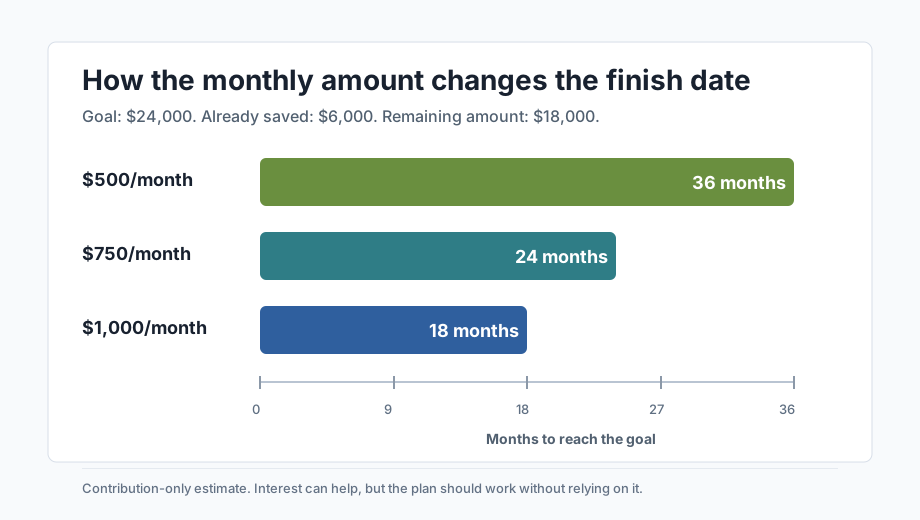
| Monthly savings | Months to save $18,000 | What it means |
|---|---|---|
| $500 | 36 months | Comfortable monthly amount, slower date |
| $750 | 24 months | Middle path: realistic and still timely |
| $1,000 | 18 months | Faster, but only if the budget can sustain it |
This is the part people often miss: increasing the monthly amount does not save the same number of months every time. Going from $500 to $750 cuts a full year off the timeline. Going from $750 to $1,000 cuts another six months. The higher you push the contribution, the more you should ask whether the squeeze is worth the time saved.
Why Interest Is Not the Plan
For short-term goals, contributions usually do most of the work. Interest can help, but it should be treated as a cushion, not the backbone of the plan.
That is why the Savings Plan is intentionally contribution-first. If your cash earns interest, great: you may arrive a little early or have extra buffer. But the plan itself asks, "Can your monthly savings get you there without depending on a return?"
This is especially useful for goals with deadlines. The Consumer Financial Protection Bureau's emergency fund guidance emphasizes building a dedicated cash reserve and making saving automatic. FDIC Money Smart materials similarly frame saving around specific goals and regular habits. The lesson is simple: for near-term money, repeatable behavior matters more than an optimistic growth assumption.
What Changes the Finish Date
Three levers move the date.
1. The Monthly Amount
This is the most obvious lever. More each month means fewer months to finish. But it is only helpful if the number survives real life.
If $1,000 a month forces you to use a credit card by week three, it is not a $1,000 plan. It is a future reset. Start with the amount that can clear your checking account on payday and still leave the rest of the budget intact.
2. The Head Start
Money already saved shortens the trip before the monthly math begins. For Maya's $24,000 goal:
| Already saved | Remaining amount | Timeline at $750/month |
|---|---|---|
| $0 | $24,000 | 32 months |
| $6,000 | $18,000 | 24 months |
| $12,000 | $12,000 | 16 months |
A bonus, tax refund, or one-time transfer can be powerful because it removes whole months from the timeline. A $6,000 head start at $750 a month is worth eight months.
3. The Target Amount
Sometimes the useful move is not saving harder. It is sizing the goal more precisely.
If the $24,000 target is a cushion for moving costs, closing costs, and furniture, Maya should break it apart. Maybe the must-have cash need is $18,000 and the furniture upgrade can wait. That changes the plan from 24 months to 16 months at the same $750/month contribution.
When the Date Is Too Late
If the calculator says the goal takes longer than your real deadline allows, do not hide from the math. Pick one of these fixes:
- Raise the monthly amount only if the budget can genuinely support it.
- Add a one-time head start from existing cash, a bonus, or a refund.
- Lower the target to the must-have amount.
- Move the deadline if the event is flexible.
- Split the goal into a starter milestone and a full milestone.
For example, if Maya needs a usable cash cushion in 12 months, $750/month will not get her to $24,000. But it will add $9,000 to her $6,000 starting balance, leaving her with $15,000. That may be enough for a starter milestone while she keeps saving toward the full amount.
Here is the deadline check at the same $750/month pace:
| Deadline | New savings added | Total with $6,000 head start | Result |
|---|---|---|---|
| 12 months | $9,000 | $15,000 | Starter milestone, $9,000 short of full goal |
| 18 months | $13,500 | $19,500 | Closer, but still $4,500 short |
| 24 months | $18,000 | $24,000 | Full goal reached |
Common Mistakes
- Starting with the dream date instead of the real monthly amount. If the monthly amount is not repeatable, the date is fiction.
- Ignoring money already saved. Your current balance is part of the plan, not a separate mental bucket.
- Counting on investment returns for a short-term deadline. Market growth can help long-term plans, but short-term goals need cash reliability.
- Treating the first missed month as failure. Update the balance and replan the remaining months.
- Using one savings pile for every goal. A down payment, trip, annual insurance bill, and emergency fund are easier to manage when each has its own target.
Make the Example Your Own
Start from Maya's $750 baseline, then test three versions:
- Lower the monthly amount to $500 and see how much later the finish date moves.
- Keep the $750 middle path and decide whether it is repeatable.
- Raise the monthly amount to $1,000 and decide whether the faster date is worth the squeeze.
Compare the derived finish date, the remaining amount, and whether the monthly amount can survive a normal year.
Related: How Much Should You Save Each Month to Reach Your Goal?
Sources and Notes
- Consumer Financial Protection Bureau — An essential guide to building an emergency fund
- Consumer Financial Protection Bureau — How to save for emergencies and the future
- FDIC Money Smart
- Investor.gov — Financial tools and calculators
This article is educational planning content, not personalized financial advice. The Savings Plan uses contribution-based math and does not guarantee that any account, budget, or timeline will be right for your situation.
More Savings Goal Planner articles
Practical examples that connect the calculator to real planning decisions.
Baby's First-Year Budget: What Costs Hit Before Birth vs After Birth?
Separate first-year baby costs into what you need before birth, what hits during leave, and what becomes a monthly budget after childcare starts.
How Much Should You Save Before Your Baby Is Born?
Plan the cash you should have ready before the due date, including gear, medical buffers, feeding and diaper supplies, and the first childcare deposit.
How Much Should You Save Each Month to Reach Your Goal?
Use a simple monthly savings formula, then adjust it for deadlines, starting balances, interest, and real-life catch-up months.