Short Answer
The useful answer is not a universal percentage. It is the monthly amount that connects four inputs: what you have now, the nest egg you want, when you want it, and the return assumption you are willing to plan around.
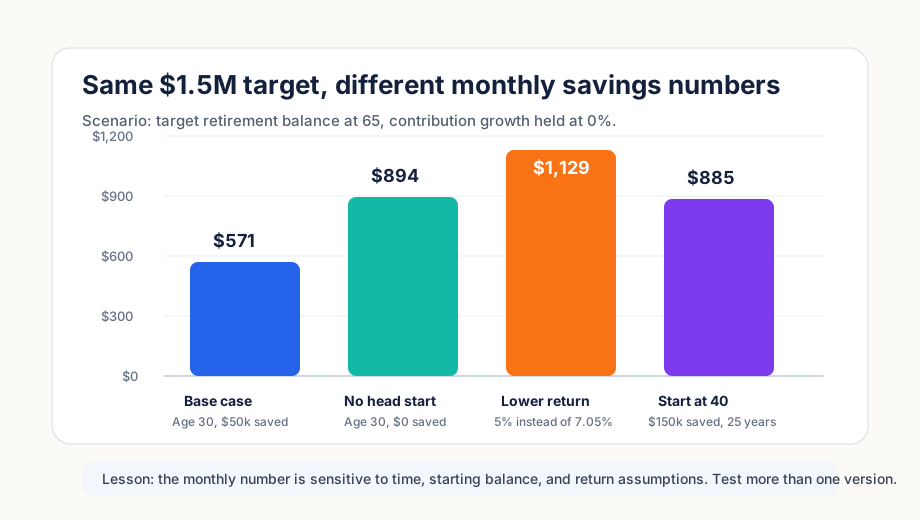
For example, a 30-year-old with $50,000 already saved, a $1.5 million retirement target at age 65, and the Retirement Saver's default 7.05% nominal blended return needs about $571 per month. That same target needs about $894 per month if the saver starts from $0, and about $1,129 per month if they plan around a more conservative 5% return.
Those numbers are planning outputs, not promises. The useful move is to start with one concrete version, then change one assumption at a time.
What "Save Each Month" Really Means
A retirement savings target is a compound-growth problem. Your future balance comes from three sources:
- Current savings that can keep growing.
- Future contributions that you make each year or month.
- Investment returns that compound on both the old balance and the new money.
That is why the monthly amount is not just:
target amount / months until retirementIf you tried to save $1.5 million over 35 years with no growth, the simple division would be about $3,571 per month. With a starting balance and decades of compounding, the required monthly contribution can be much lower. The CFPB describes compound interest as earning on both the money you saved and the interest already earned, which is exactly the force a retirement plan is trying to use.
The opposite is also true: if the return assumption is too optimistic, the monthly number can look easier than it really is. A retirement savings plan should be stress-tested, not treated as a guarantee.
Example Scenario: Alex Wants $1.5 Million by 65
Here is one concrete scenario:
| Input | Value |
|---|---|
| Current age | 30 |
| Retirement age | 65 |
| Current retirement savings | $50,000 |
| Target nest egg | $1,500,000 |
| Planning horizon | 35 years |
| Return assumption | 7.05% nominal |
| Contribution growth | 0% |
The 7.05% default comes from the app's simple blended assumption: 80% stocks at 8%, 15% bonds at 4%, and 5% cash at 1%. It is a nominal planning assumption, which means it does not subtract future inflation.
With those inputs, Alex needs about:
| Output | Amount |
|---|---|
| Annual contribution | $6,850 |
| Monthly equivalent | $571 |
| Projected target balance | $1,500,000 |
That monthly number is the baseline habit. The actual account balance will not move in a straight line because investment returns do not arrive evenly, but the contribution is the action Alex can control.
Open the prefilled Alex monthly savings scenario to start with the assumptions above, then map the age, current balance, target age, target nest egg, return, and contribution-growth assumptions to your situation.
What Changes the Answer
The monthly target moves when you change one of the major assumptions. Here are four versions of the same $1.5 million goal.
| Scenario | What changed | Monthly amount |
|---|---|---|
| Base case | Age 30, $50,000 saved, 7.05% return | $571 |
| No head start | Age 30, $0 saved, 7.05% return | $894 |
| Conservative return | Age 30, $50,000 saved, 5% return | $1,129 |
| Start at 40 | Age 40, $150,000 saved, 7.05% return | $885 |
The table shows why two people with the same retirement target can need very different monthly numbers. A strong starting balance can reduce the required contribution. A lower return assumption can raise it sharply. Starting later usually raises it because there are fewer compounding years left.
Should You Use a Percentage Rule?
Percentage rules are useful for a first guess. Saving 10%, 15%, or 20% of income is easier to remember than a compound-growth model. But a percentage rule cannot see:
- Your current balance.
- Your target retirement age.
- Your actual target nest egg.
- Your portfolio assumption.
- Employer match.
- Paused years, catch-up years, or contribution increases.
If you earn $80,000 and save 15%, you are saving $12,000 per year, or $1,000 per month. For Alex's base case, that is more than the $571 solved amount. For someone starting later, it may not be enough. The point is not that 15% is right or wrong. The point is that you should translate the rule into a plan and see whether it lands at the target.
How 2026 Contribution Limits Fit In
Contribution limits matter because they create practical ceilings for tax-advantaged accounts. For 2026, the IRS announced a $24,500 employee contribution limit for 401(k), 403(b), most 457 plans, and the federal Thrift Savings Plan. The IRA contribution limit increased to $7,500. Catch-up limits apply for eligible older savers.
Those limits are not the same thing as your required contribution. In Alex's base case, the solved amount is about $6,850 per year, well below the 2026 401(k) employee deferral limit. A higher-income saver trying to retire early may need more. A saver with a large existing balance may need less.
One way to use the limits is as a benchmark:
| Contribution plan | Annual amount | What it means |
|---|---|---|
| Alex's solved amount | $6,850 | The amount needed for this $1.5M target under the stated assumptions. |
| 2026 401(k) employee limit | $24,500 | A tax-advantaged ceiling for many workplace plans, not a universal requirement. |
| 2026 401(k) plus IRA limits | $32,000 | A useful high-savings scenario if the saver is eligible and cash flow supports it. |
If Alex contributed the full $24,500 per year for 35 years under the same 7.05% assumption, the projected balance would be much higher than $1.5 million. That is not bad. It just means the target, retirement age, or later contribution plan should be reviewed instead of blindly saving the maximum forever.
Use Contribution Growth if Raises Are Part of the Plan
Many people cannot start with the perfect number. A better question is:
What can I start with now, and how much should it grow as my income grows?
In the same Alex scenario, a flat contribution needs about $571 per month. If Alex plans for contributions to rise 3% per year, the first-year monthly amount falls to about $402, but the later-year contributions rise with the plan.
That can be realistic for an early-career saver whose income is likely to grow. It can also be dangerous if the raises never arrive or lifestyle spending absorbs them. The Retirement Saver includes a contribution-growth input so you can decide whether that tradeoff is honest for your situation.
A Practical Way to Run Your Own Number
Use the same input checklist from the example:
- Your current age.
- Your target retirement age.
- Your current retirement savings.
- Your target nest egg.
- A return assumption you are willing to plan around.
Then run three versions:
| Test | Why it matters |
|---|---|
| Base case | Shows the monthly amount under your current best assumptions. |
| Lower return | Shows whether the plan depends on an aggressive market assumption. |
| Later or earlier retirement age | Shows whether the timeline is doing more work than the contribution. |
If your solved monthly number is too high, do not stop at "I failed." Change one lever at a time. Retire later, lower the target, plan contribution growth, add an employer match, or use the full Retirement Calculator to test whether the target itself is too conservative or too thin.
When This App Is Not Enough
The Retirement Saver is for accumulation. It helps you answer "What should I contribute?" and "Am I still on track?"
Use the Financial Independence Planner when the question becomes:
- What age can I retire with this monthly spending?
- What can I spend if I retire at a specific age?
- How much does changing the retirement age move the answer?
Use the deeper Retirement Calculator when the question becomes:
- How much can I spend in retirement?
- How should Social Security timing change the plan?
- What happens if bad market returns arrive early?
- Which withdrawal strategy should I use?
- Can I retire before 59 1/2 or before Medicare?
Those are retirement-income questions. They need withdrawal modeling, not just savings accumulation.
Make the Example Your Own
Start from Alex's baseline, then test three versions:
- Keep the $1.5 million target but replace the current balance and age.
- Lower the return assumption to see whether the monthly number still fits.
- Add contribution growth only if raises or step-ups are realistic.
Compare the required monthly contribution, annual contribution, and target-date balance before changing the nest egg.
Related: Are You On Track for Retirement?.
Sources
- IRS - 401(k) limit increases to $24,500 for 2026, IRA limit increases to $7,500
- IRS - Retirement topics: contributions
- U.S. Department of Labor - Retirement Savings and Planning
- U.S. Department of Labor - Retirement Savings Toolkit
- CFPB - How does compound interest work?
- Investor.gov - Tools and Calculators
This article is educational and not personalized financial, tax, legal, retirement, or investment advice.
More Retirement Saver articles
Practical examples that connect the calculator to real planning decisions.