Short Answer
High school is usually too early to pick one exact job. It is not too early to pick better directions to explore.
The useful question is not "What should I be forever?" It is "Which major and career-path families are worth testing next, given what I like, what I do well in, what I have seen and liked, and how much school feels realistic?"
That is why the High School Career Direction Advisor ranks broad pathways instead of narrow job titles. A student may compare engineering, computer science, nursing, allied health, business, trades, education, law and policy, creative work, public service, and science before choosing a specific major or credential.
Why High-School Career Planning Should Start Broad
Many career quizzes jump too quickly to job titles. That can feel precise, but it is often the wrong kind of precision for a high-school student.
Most students do not yet have enough evidence to know whether they want the daily work of a specific occupation. They do have earlier signals:
- Classes or topics that pull them in.
- Subjects where success gives them confidence.
- Adults or role models they have seen and liked.
- Goals such as income, security, helping people, creative work, independence, or low debt.
- A realistic sense of school runway: apprenticeship, two-year program, four-year degree, or graduate/professional school.
Those signals are enough to build a direction. They are not enough to declare a destiny.
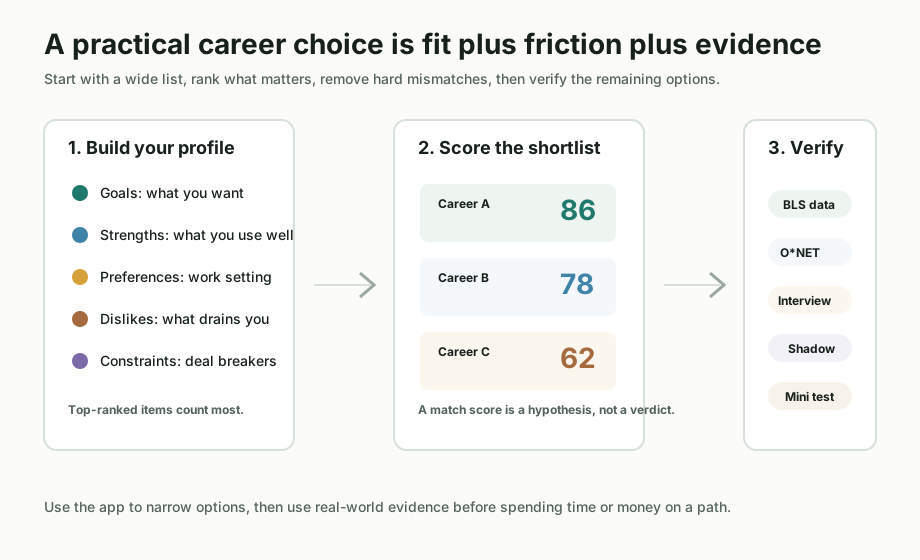
The Five Signals That Matter First
Use five kinds of evidence before comparing majors or career paths.
| Signal | What it tells you | Example |
|---|---|---|
| Subjects you like | Where curiosity naturally goes | Biology, physics, history, writing, business, art, shop, languages |
| Subjects you do well in | Where school evidence supports the path | Strong math, strong writing, strong science labs, strong CTE classes |
| What you want | What the path should do for your life | High income, helping people, security, creative work, low debt, hands-on work |
| School runway | How much training feels realistic | Paid training, two-year program, four-year degree, graduate school |
| Seen and liked | Real-world exposure that made a path feel appealing | Nurses, engineers, tradespeople, teachers, business owners, designers |
The important move is separating "like" from "do well in." A student can like medicine but not yet have the science grades for a selective pre-med path. A student can do well in math but dislike desk-heavy work. A student can love art and still want a business or technology route where creative skill has a clearer income path.
Example: Alex Has Too Many Interests
Alex is a junior who likes biology, psychology, sports science, and business. School is going fine, but Alex is strongest in health and writing classes, not advanced math. Alex wants security, helping people, and a path that does not require huge debt.
That profile should not instantly become "doctor" or "business major." A better first shortlist might compare:
| Direction | Why it belongs | What to test next |
|---|---|---|
| Nursing pathway | Health interest, helping goal, strong demand, clear credential | Talk to RN/BSN programs about prerequisites and clinical expectations |
| Allied health tech pathway | Health plus practical training, often shorter than medical school | Compare radiology, dental hygiene, respiratory therapy, lab, and therapy-support programs |
| Sports / kinesiology / recreation pathway | Sports science interest and people-facing work | Check which roles need graduate school and which are available with a bachelor's degree |
| Psychology / behavioral science pathway | Psychology plus helping and writing strengths | Learn the difference between bachelor's-level work and licensed counseling paths |
| Finance / accounting / business pathway | Business interest and security goal | Test whether numbers, operations, sales, or management work actually feels appealing |
The result is not "Alex should become a nurse." The result is "Alex should investigate these pathways before paying for a major."
How to Use the Advisor
Open the High School Career Direction Advisor and fill it out in this order:
- Pick subjects you like.
- Pick subjects you do well in.
- Rank what you want the path to do.
- Answer school runway honestly.
- Add real-world paths you have seen and liked.
Then read the results as a ranked exploration list with two separate signals.
The illustrative readiness signal is separate from pathway fit: fit reflects the subjects, goals, schooling preferences, exposure, and strengths you supplied, while the readiness signal combines broad pathway gates with your school situation and real reps. It does not verify a current school, program, credential, sponsor, employer, seat, opening, or offer.
The advisor combines those two signals into five result bands:
| Result label | How to read it |
|---|---|
| Strong pathway fit · favorable readiness signal | Strong fit; comparatively favorable readiness evidence |
| Strong pathway fit · readiness signal needs checking | Strong fit; check current route evidence |
| Good pathway fit · favorable readiness signal | Good fit; comparatively favorable readiness evidence |
| Good pathway fit · readiness signal needs checking | Good fit; check current route evidence |
| Some pathway fit · compare readiness evidence | Some fit; compare readiness evidence before prioritizing |
If a path surprises you, do not delete it immediately. Ask which input lifted it. Was it a subject? A goal? Something you have seen and liked? A school-runway choice?
Do Not Treat "School Isn't a Strength Right Now" as a Life Sentence
School performance should change the ranking, but it should not humiliate the student or close every door.
If school is not a strength right now, the advisor should make grade-gated paths more cautious. Medicine, engineering, selective nursing programs, and some science paths may become stretches. That does not mean the student has no future in health, technology, business, trades, public service, or creative work.
The practical question is: which nearby routes have a realistic gate?
For example:
- Healthcare can mean pre-med, nursing, allied health tech, caregiving, public health, lab work, operations, or medical administration.
- Technology can mean computer science, IT support, cybersecurity, data, CAD, product, or technical sales.
- Business can mean accounting, finance, operations, logistics, sales, marketing, entrepreneurship, or management.
- Hands-on work can mean engineering, architecture, construction management, skilled trades, manufacturing, utilities, or field service.
Granularity matters. "Healthcare" is too broad. "Pre-med," "nursing," "allied health tech," and "caregiving / health support" have different gates.
How to Turn a Direction Into Next Steps
For each top pathway, collect three kinds of evidence.
| Evidence | What to do |
|---|---|
| School evidence | Which classes, grades, prerequisites, or CTE programs support this path? |
| Program evidence | Which majors, certificates, apprenticeships, or two-year programs lead into it? |
| Work evidence | What do people actually do all day, and what does entry look like? |
Good next steps for a high-school student:
- Ask a school counselor which classes keep the path open.
- Compare the major requirements at two colleges or community colleges.
- Look up one occupation in the BLS Occupational Outlook Handbook.
- Use O*NET OnLine to inspect tasks, work activities, interests, and work context.
- Ask one person in the field what they wish they had known in high school.
- Try a small sample: coding project, shadow day, design portfolio piece, intro accounting lesson, first-aid course, shop project, writing sample, or volunteer shift.
The BLS also has a Teacher's Guide to the Occupational Outlook Handbook that explains how students can use occupation pages to compare work, education, pay, and outlook.
When to Switch to the Career Path Advisor
Use the High School Career Direction Advisor when the question is still broad:
- What major families should I consider?
- What classes should I take next?
- Is this a realistic direction or a stretch?
- Which career paths should I learn more about?
Use the Career Path Advisor later, when the question becomes more concrete:
- I am in college and have a major or concentration.
- I finished high school and need a first path.
- I graduated and need a first serious role.
- I am comparing starter jobs, credentials, internships, portfolios, or training programs.
The high-school advisor points toward directions. The Career Path Advisor compares launch paths.
Common Mistakes
- Picking a major only because a subject is fun, without checking the work it leads to.
- Picking a prestigious path without checking the school gate.
- Ignoring trades, allied health, technical programs, and public service because they do not sound like "college career quiz" answers.
- Treating one weak class as proof that a whole field is impossible.
- Treating one strong class as proof that the daily work will feel good.
- Choosing by salary without checking training time, debt, schedule, and entry odds.
Make the Example Your Own
Start with your top five pathways. For each one, write:
| Pathway | Why it showed up | Main gate | Best next test |
|---|---|---|---|
| Nursing | Health interest, helping goal, clear credential | Program prerequisites and clinical comfort | Talk to a nursing program and a working nurse |
| Engineering | Math/physics interest, building goal, high upside | Strong math sequence | Try CAD, robotics, or intro engineering and check college prerequisites |
| Business | Income, leadership, flexibility | Choosing a lane | Compare accounting, finance, marketing, analytics, and operations |
Then update the advisor profile after you collect evidence. A good career direction should survive contact with real classes, real programs, and real workers.
Sources
- BLS Occupational Outlook Handbook
- BLS Occupation Finder
- BLS Teacher's Guide to the Occupational Outlook Handbook
- O*NET OnLine
- O*NET Career Exploration Tools
- O*NET Interest Profiler
This article is educational career-planning content. It is not career counseling, academic advising, employment advice, or a promise that a specific occupation will be right for a specific person.
Run the scenario yourself
Open the calculator, adjust the assumptions, and compare the result to the article.