"Rent is throwing money away" is a sticky phrase because it feels obvious. A homeowner builds equity. A renter sends money to a landlord.
But the rent-vs-buy question is not that simple. Buying also throws money at interest, property tax, insurance, maintenance, closing costs, and selling costs. Renting can free up cash that gets invested instead. The real question is not "Who owns the house?" It is which path leaves you with more net worth after housing costs and investments are counted together?
The short version:
- Buying is not automatically cheaper, even if you stay a long time. High mortgage rates, low rent, high ownership costs, or strong investment returns can keep renting ahead.
- Renting only wins if the renter invests the difference. If the down payment and monthly savings get spent, the math changes.
- The answer depends on a whole scenario, not one payment. Home price, rent, rate, down payment, appreciation, rent growth, taxes, maintenance, and selling costs all matter.
- Your own numbers matter most. The useful levers to pressure-test are rent, mortgage rate, investment return, ownership costs, and how long you expect to stay.
What "Renting And Investing The Difference" Means
A fair rent-vs-buy comparison has to give both sides a realistic path.
The buyer uses cash for a down payment and closing costs. Over time, the buyer builds home equity as the loan balance falls and the home may appreciate. If they sell later, they receive the home value minus the remaining mortgage and selling costs.
The renter does not build home equity, but they also do not tie up the down payment. In a full comparison, the renter invests:
- The down payment they did not make.
- The closing costs they did not pay.
- Any month where renting costs less than owning.
That is why renting can be financially strong without pretending rent is free. The rent payment buys housing for that month. The wealth-building happens in the investment account instead of inside the house.
A Concrete 2026 Scenario
Use this as a simple test case, not a prediction.
| Input | Value |
|---|---|
| Home price | $500,000 |
| Down payment | 20% ($100,000) |
| Mortgage | 30-year fixed at 6.5% |
| Monthly rent for similar home | $2,500 |
| Home appreciation | 3% per year |
| Rent growth | 3% per year |
| Renter investment return | 7% per year |
| Closing costs | 3% of purchase price |
| Selling costs | 6% of sale price |
| Comparison horizon | 30 years |
| First-year property tax, insurance, maintenance | Plan in 30 defaults for a $500,000 home |
Open the prefilled renting-and-investing scenario to start with the assumptions above, then map the rent, home price, mortgage rate, investment return, ownership costs, and expected stay to your situation.
This is the kind of scenario where the monthly mortgage payment alone can mislead you. The buyer may say, "At least part of my payment builds equity." True. But the renter starts with roughly $115,000 still invested: the $100,000 down payment plus about $15,000 of closing costs the buyer paid upfront.
In the first year, the buyer also has principal and interest, property tax, insurance, maintenance, and other ownership costs. If the renter's $2,500 payment is materially lower than the buyer's all-in cost, the renter has another monthly amount to invest.
That combination can matter more than the emotional appeal of owning.
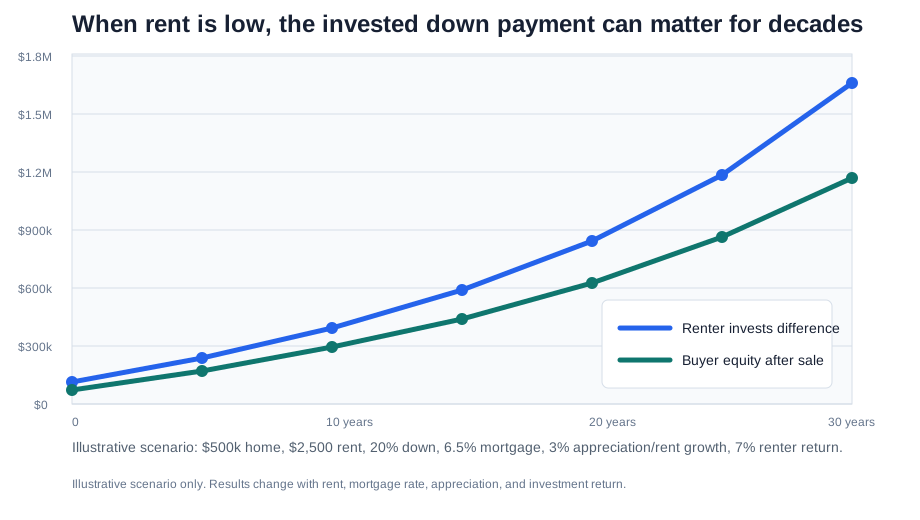
The current Plan in 30 engine keeps renting ahead in this exact scenario for the full 30-year horizon: about $57,000 ahead at year 3, $78,000 ahead at year 7, $99,000 ahead at year 10, and roughly $493,000 ahead by year 30. Rerun the scenario before using it because rates, taxes, insurance, and local costs change.
Why The Buyer Can Stay Behind
There are four main reasons buying can fail to catch up.
1. The House Is Expensive Compared With Rent
A $500,000 home with $2,500 rent has a price-to-rent ratio of 16.7:
$500,000 / ($2,500 x 12) = 16.7
That does not prove renting wins, but it tells you the home price is high compared with the rent. The buyer needs appreciation, mortgage payoff, and stable ownership costs to overcome a large upfront investment.
If the equivalent rent were $3,500 or $4,000, the same home could look much more buy-friendly. That is why the article The Price-to-Rent Ratio, Explained for Normal People treats rent as one of the most important levers.
2. The Mortgage Rate Raises The Hurdle
A higher mortgage rate does not just increase the monthly payment. It also slows the buyer's early equity progress because more of each payment goes to interest.
Mortgage rates change weekly, so do not treat 6.5% as a permanent assumption. Freddie Mac's Primary Mortgage Market Survey and FRED's 30-Year Fixed Rate Mortgage Average are useful context, but your lender quote is the number that belongs in your scenario.
3. Ownership Has Friction On Both Ends
The buyer pays to enter and exit the transaction.
Closing costs, lender fees, title charges, inspections, prepaid items, and moving costs can make the starting line expensive. Later, selling costs can take a meaningful bite out of the home value. The CFPB's homebuying resources are a good reminder that the loan offer, closing process, and total cash needed deserve close attention.
Those costs are one reason a short stay often favors renting. But in a low-rent market, they can also matter over a longer horizon.
4. The Renter's Investment Assumption Is Load-Bearing
The renter's advantage is not magic. It depends on actually investing the cash that would have gone into the home.
If the renter keeps the down payment invested and automates the monthly difference, renting can build wealth outside the house. If the renter spends the difference, the comparison changes quickly.
That is the most honest way to read this article: renting is not automatically better either. Renting wins only when the full behavior matches the math.
What Changes The Answer?
Run the same scenario in the calculator and change one input at a time.
| Change | Why it matters | Direction |
|---|---|---|
| Rent rises from $2,500 to $3,200 | Renting becomes more expensive relative to the same home | Buying catches up sooner |
| Mortgage rate falls from 6.5% to 5.5% | The buyer's monthly cost and interest drag fall | Buying improves |
| Investment return falls from 7% to 5% | The renter's invested cash compounds more slowly | Buying improves |
| Home appreciation rises from 3% to 5% | The buyer's asset grows faster | Buying improves |
| Selling after 3 years instead of 10 | Transaction costs have less time to amortize | Renting improves |
| Maintenance or insurance runs high | Ownership costs absorb more cash | Renting improves |
The point is not to hunt for an input that proves your preferred answer. The point is to find the handful of assumptions where the decision flips. Those are the assumptions worth stress-testing.
Common Mistakes
Mistake: Comparing Rent To Principal And Interest Only
Principal and interest are not the full cost of owning. Add property tax, homeowner's insurance, maintenance, HOA dues, PMI if applicable, and likely repairs. Then compare the all-in number to rent.
Mistake: Ignoring The Down Payment
A down payment is not just cash paid to the seller. It is also money that can no longer compound in a separate investment account. That opportunity cost is real.
Mistake: Assuming Appreciation Is Guaranteed
Homes can appreciate, stagnate, or fall. Even when the long-term trend is positive, your specific neighborhood and ownership window matter.
Mistake: Treating Flexibility As Worth Zero
A renter who expects to relocate, change jobs, or change household size has a real option value. The calculator focuses on money, but the life flexibility can matter too.
Make the Example Your Own
Start from the article assumptions, then test these versions:
- Raise rent to $3,200 to see how quickly the same home can move toward buying.
- Use your actual mortgage quote instead of the 6.5% placeholder.
- Lower the investment return to 5% to pressure-test the renter's side.
- Shorten the stay to 7 years or 3 years if you may move sooner.
- Increase insurance, maintenance, or HOA costs if local ownership costs are higher than the defaults.
Then ask the practical question: how wrong would one assumption have to be before the answer flips?
If buying still wins in your own scenario, that is useful. If renting stays ahead, that is useful too. Either way, the goal is not to defend renting or buying. The goal is to make a housing decision that fits your cash flow, timeline, risk, and real alternatives.
Sources And Further Reading
- Consumer Financial Protection Bureau homebuying tools
- Freddie Mac Primary Mortgage Market Survey
- FRED 30-Year Fixed Rate Mortgage Average
- Zillow buy-versus-rent breakeven methodology
Educational only. This is not personalized financial, tax, or investment advice.
Related
- Rent vs. Buy: How to Find Your Break-Even Point — find the exact break-even year for your own numbers, the buyer-side companion to this renter-side case
- The Price-to-Rent Ratio, Explained for Normal People — screen the market before you model
More Rent vs Buy Calculator articles
Practical examples that connect the calculator to real planning decisions.
The Price-to-Rent Ratio, Explained for Normal People
Learn the price-to-rent ratio formula, see a 2026 example, and test whether buying or renting looks stronger in the Rent vs. Buy Calculator.
Rent vs. Buy: How to Find Your Break-Even Point (2026)
Find your rent-vs-buy break-even year with a worked 2026 scenario and the three levers that most change the result.