Minimum payments are useful for one thing: keeping the account current. They are not designed to make the balance disappear quickly.
The trap is that the required payment often falls as the balance falls. That feels easier month by month, but it also means your payoff plan can slow down right when you need momentum.
Short Answer
If you owe $6,000 on a credit card at 24% APR, an illustrative minimum-payment formula can keep the debt around for about 18 years and cost about $10,400 in interest, assuming no new purchases or fees.
The same balance with a fixed $300 monthly payment can be gone in about 26 months with about $1,700 of interest.
That is the difference between a payment floor and a payoff plan:
| Strategy | First payment | Payoff time | Estimated interest | Total paid |
|---|---|---|---|---|
| Minimum-style payment | $180, then falling | 219 months | ~$10,400 | ~$16,400 |
| Fixed $300 payment | $300 | 26 months | ~$1,700 | ~$7,700 |
| Fixed $400 payment | $400 | 19 months | ~$1,200 | ~$7,200 |
These are simplified planning estimates, not a prediction of your exact statement. Your issuer's formula, fees, rate changes, new purchases, and payment timing can change the result. But the lesson is durable: a shrinking minimum payment can quietly stretch the finish line.
What a Minimum Payment Really Means
A minimum payment is the smallest payment required to keep the account in good standing for that cycle. Paying it on time matters. It can help you avoid late fees, penalty APRs, and credit-score damage from delinquency.
But the minimum is not the lender saying, "This is the best way to get out of debt." It is the account's floor.
Credit card minimum formulas vary. The Consumer Financial Protection Bureau describes common structures such as a fixed floor, a percentage of the balance, or a percentage of the balance plus interest and fees. That last structure is important because it can make the minimum move down as the balance moves down.
For a payoff plan, the dangerous part is not only the first minimum. It is the pattern:
- The balance falls a little.
- The minimum falls too.
- The payment stays near the floor.
- Interest keeps taking a meaningful share.
- The finish line moves far into the future.
Why It Matters
Minimum payments can make a debt feel manageable while keeping it expensive.
Imagine seeing a $180 minimum payment on a $6,000 card. That payment might fit the budget. It might even feel responsible because it is more than zero and it keeps the account current.
The problem is that at 24% APR, the first month starts with about $120 of interest. A $180 payment reduces principal by only about $60.
| First month item | Amount |
|---|---|
| Starting balance | $6,000 |
| Estimated monthly interest | $120 |
| Minimum-style payment | $180 |
| Principal reduction | $60 |
| Ending balance | $5,940 |
You paid $180, but only one-third of that first payment actually reduced the debt.
That is why two people can both say, "I pay every month," while one gets out in two years and the other carries the same debt for more than a decade.
Example Scenario: Maya's $6,000 Card
Maya has one credit card:
| Input | Scenario |
|---|---|
| Current balance | $6,000 |
| APR | 24% |
| New purchases | $0 |
| Fees | $0 |
| Goal | Pay the balance to $0 |
To keep the comparison transparent, we will use an illustrative minimum formula:
Monthly minimum = the greater of $35 or interest plus 1% of the starting balance
That means month one is about $120 of interest plus $60 of principal, or $180 total. As the balance falls, the calculated minimum falls too. Eventually the $35 floor takes over.
Now compare that with two fixed payments.
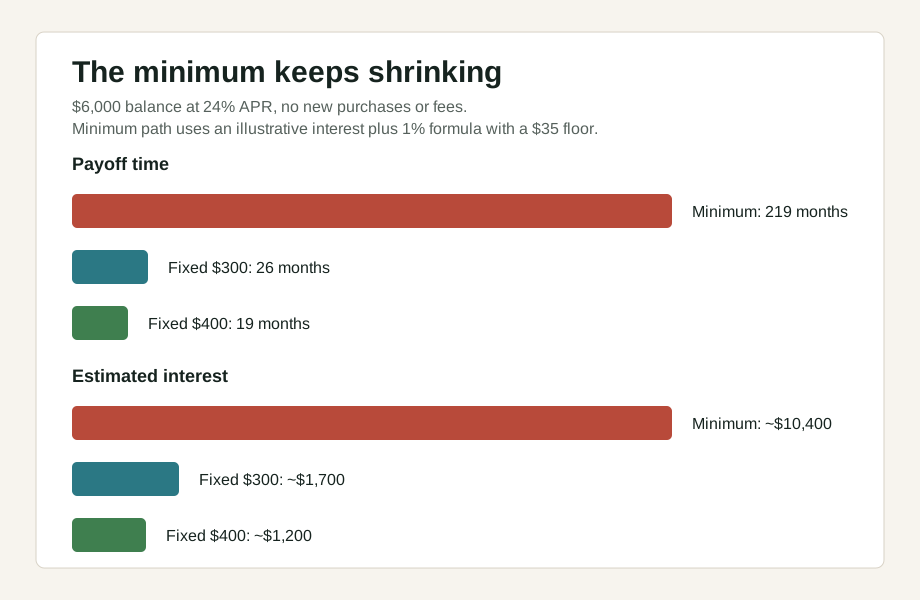
A fixed payment lets lower interest accelerate principal. A falling minimum gives that advantage back.
What the Calculator Shows
The minimum-style path is an illustrative statement-payment pattern. The calculator is most useful for testing fixed-payment alternatives against the same balance and APR.
Open the prefilled Maya fixed-payment scenario to start with the $6,000 balance, 24% APR, and $300 fixed payment, then map the balance, APR, and repeatable payment to your situation.
Then test three versions:
| Version | What to enter | What to watch |
|---|---|---|
| Minimum-style path | Start near the statement minimum and let the payment fall in your own tracking notes | Whether the balance still feels stuck after a year |
| Fixed $300 path | Enter $300 as the monthly payoff payment | Payoff date, total interest, and first six balances |
| Fixed $400 path | Enter $400 as the monthly payoff payment | Whether the shorter timeline is worth the extra $100 |
The important comparison is not just "Can I make the payment?" It is:
- How much of the first payment reaches principal?
- Is the payment fixed or shrinking?
- How long until the balance is gone?
- How much interest do I pay to keep the monthly payment low?
For Maya, the fixed $300 payment pays about $180 toward principal in month one. That is three times the principal reduction of the minimum-style payment.
The Part People Miss: The Payment Falls
If Maya keeps following the illustrative minimum, the required payment keeps getting smaller:
| Month | Approx. payment | Approx. principal reduction | Remaining balance |
|---|---|---|---|
| 1 | $180 | $60 | $5,940 |
| 12 | $161 | $54 | $5,318 |
| 36 | $127 | $42 | $4,178 |
| 60 | $99 | $33 | $3,283 |
| 120 | $54 | $18 | $1,796 |
| 180 | $35 | $16 | $932 |
After five years, the balance is still over $3,000 in this simplified model. After ten years, it is still near $1,800.
That does not happen because Maya skipped payments. It happens because she kept making a payment that was allowed to shrink.
Minimum Payment vs Fixed Payment
A fixed payment changes the shape of the plan.
With a fixed $300 payment, the first month still has about $120 of interest. But the payment is large enough that about $180 reduces principal. The next month's interest is lower, so more of the same $300 reaches principal. That creates a positive loop:
- Fixed payment reduces principal faster.
- Lower principal creates lower interest.
- Lower interest lets more of the fixed payment hit principal.
- The payoff accelerates.
The minimum-style path does the opposite. The payment falls with the balance, so the plan does not get the full benefit of lower interest.
What About the 3-Year Payoff Box?
Credit card statements include repayment disclosures. The CFPB explains that the statement can show how long payoff would take if you made no new charges and paid only the minimum, plus the monthly payment needed to pay the current balance in about three years.
That box is helpful because it tells you the minimum is not the only option. But it is not a guarantee if you keep using the card, miss payments, pay late, or face fees and rate changes.
Use it as a checkpoint:
- If the 3-year payment fits, test that amount as a fixed payment.
- If it does not fit, test a smaller fixed number and look honestly at the payoff date.
- If even the minimum does not fit, the immediate problem is cash-flow stabilization, not optimization.
A Better Payment Rule
Use this practical rule:
Pay every required minimum on time, then choose a fixed payment that makes the balance visibly fall after interest.
For the first month, Maya's options look like this:
| Payment | First-month interest | First-month principal | Signal |
|---|---|---|---|
| $180 minimum-style | ~$120 | ~$60 | Current, but slow |
| $300 fixed | ~$120 | ~$180 | Clear payoff progress |
| $400 fixed | ~$120 | ~$280 | Faster payoff mode |
If interest is eating most of the payment, do not shame yourself. Treat it as information. The plan needs either a higher payment, a lower APR, fewer new charges, or a different debt-relief path.
Common Mistakes
Treating the minimum as the target
The minimum is the floor. A payoff plan needs a target payment, not just a required payment.
Letting the payment shrink automatically
If you were paying $180 last month and the new minimum is $176, keeping the payment at $180 helps. Raising it to a fixed $250 or $300 helps more.
Adding new purchases during the payoff plan
New charges reset the math. If the payoff card keeps absorbing groceries, travel, or annual bills, the calculator result will look better than reality.
Sending extra money to one card while another account goes late
Every strategy starts with required payments on every account. Extra principal is useful only after the basics are current.
Ignoring hardship options when the minimum is unaffordable
If you cannot cover required minimums, contact the issuer, consider nonprofit credit counseling, and be cautious about companies that demand upfront fees for debt relief.
Make the Example Your Own
Start from Maya's fixed-payment baseline, then test three versions:
- Keep $300 and note the payoff date and total interest.
- Raise the payment to $400 and compare the interest savings.
- Lower the payment toward the statement minimum and check whether the timeline still feels acceptable.
Compare payoff date, total interest, and whether the payment is realistic enough to repeat.
Related: How Long Will It Take to Pay Off My Credit Card? and Debt Snowball vs Avalanche.
Bottom Line
Minimum payments are not bad. They are essential when money is tight, and they keep the account current.
But if your goal is to get out of debt, the minimum is usually too passive. A fixed payment turns the plan from "stay current" into "make the balance disappear."
Start with the payment you can sustain, then test what a little more buys. The goal is not one heroic month. The goal is a payment you can repeat until the balance is gone.
This article is educational planning content, not personalized financial, legal, credit, or debt counseling advice. Your payoff result depends on your issuer's terms, APR, fees, payment timing, and whether you make new purchases.
Sources
- Consumer Financial Protection Bureau, Understanding minimum payments.
- Consumer Financial Protection Bureau, Credit card statement 3-year payoff disclosure.
- Consumer Financial Protection Bureau, Regulation Z payment allocation rule.
- Consumer Financial Protection Bureau, The Consumer Credit Card Market, December 2025 report.
- Federal Trade Commission, How To Get Out of Debt.
- Federal Reserve, Consumer Credit - G.19.
More Debt-Free Planner articles
Practical examples that connect the calculator to real planning decisions.
Debt Snowball vs Avalanche: Which Payoff Method Should You Use?
Compare debt snowball and avalanche with a payoff scenario, interest estimate, first-win timeline, and calculator steps for choosing your method.
How Long Will It Take to Pay Off My Credit Card?
See how long an $8,000 credit card balance takes to pay off at 22% APR with $250, $400, or $600 monthly payments, plus steps to test your own payoff date.