A 529 plan is usually the better college-specific savings bucket when the money is likely to be used for qualified education expenses. A taxable brokerage account can still be the better fit when flexibility matters more than tax savings.
The practical answer is not "529 good, brokerage bad." The right question is: how much of this money are you confident will be used for education, and how much flexibility do you need if the plan changes?
The short version:
- A 529 can offer federal tax-free growth and withdrawals when used for qualified education expenses.
- Some states add a deduction or credit, but state rules vary and should be checked before relying on them.
- A taxable brokerage account can be used for anything, but dividends, interest, and realized gains can create tax drag along the way.
- Overfunding a 529 is manageable, but it is still a planning issue.
- The best setup for many families is a core 529 target plus a flexible taxable or cash buffer.
What A 529 Plan Does
A 529 plan, also called a qualified tuition program, is a tax-advantaged account designed for education costs. The IRS describes qualified tuition programs as state, agency, or eligible institution programs that let contributors prepay or save for qualified education expenses. See IRS Topic No. 313 on Qualified Tuition Programs and IRS Publication 970.
For planning purposes, the key advantage is simple: if withdrawals are used for qualified education expenses, the investment growth can avoid federal income tax. That is different from a taxable brokerage account, where interest, dividends, and realized gains may be taxable.
That does not make a 529 free money. It makes the account powerful when the use case is clear.
What A Taxable Brokerage Account Does
A taxable brokerage account is flexible. It can pay for college, a gap year, a first apartment, a car, graduate school outside the 529 rules, or a family emergency. There is no education-only wrapper around the account.
The tradeoff is tax drag. Depending on the investments and how often gains are realized, some of the return may be reduced by taxes before the money is needed. A low-turnover index portfolio may have modest drag. A high-yield or actively traded portfolio may have more.
That is why the comparison should use a scenario instead of a slogan.
Example Scenario: $300 A Month For 12 Years
Assume a family has a 6-year-old, $10,000 already saved, and 12 years until the first college bill. They can contribute $300 per month.
| Input | 529 scenario | Taxable brokerage scenario |
|---|---|---|
| Starting balance | $10,000 | $10,000 |
| Monthly contribution | $300 | $300 |
| Time until college | 12 years | 12 years |
| Gross return assumption | 6.0% | 6.0% |
| Tax drag assumption | 0.0% if used for qualified expenses | 0.9 percentage points |
| Modeled after-tax return | 6.0% | 5.1% |
| Assumed state tax value | 5% of annual contributions | None |
This is only an example. Your state tax benefit, investment mix, and realized tax drag may be different.
Open the prefilled 529 account-choice scenario to start with the 529-side assumptions above, then map the child age, current balance, monthly contribution, return, state tax assumptions, and tax-drag assumption to your situation.
What The Calculator Scenario Shows
Using those assumptions, the 529 ends near $83,600 after 12 years. The taxable account ends near $77,800 after the same contributions and lower after-tax return assumption.
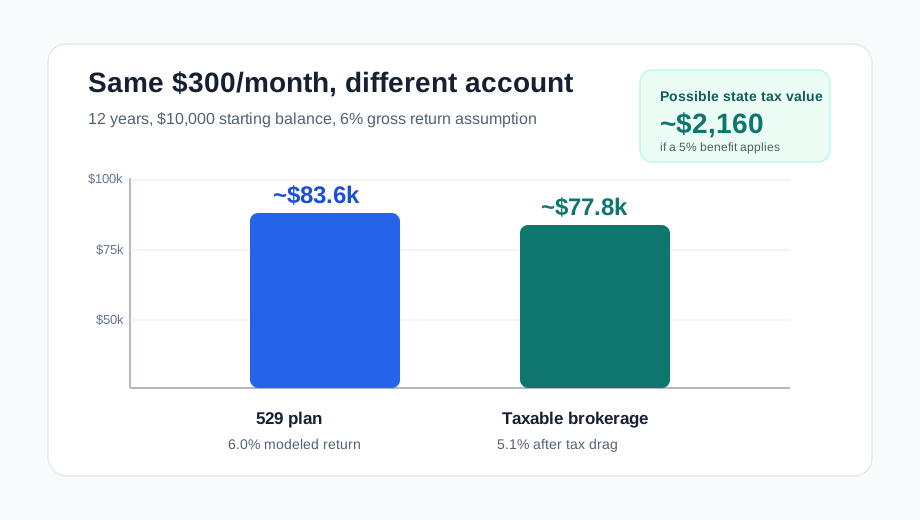
Same starting balance, same monthly contribution, same time horizon. The difference is the account wrapper and the assumed tax drag.
| Result | 529 plan | Taxable brokerage |
|---|---|---|
| Estimated ending balance | ~$83,600 | ~$77,800 |
| Difference from account growth | +~$5,700 | Baseline |
| Possible state tax savings over 12 years | ~$2,160 | $0 |
| Education-use restrictions | Higher | Lower |
| Non-college flexibility | Lower | Higher |
The 529 looks better if the money is likely to be used for qualified education costs. In this example, it creates roughly $5,700 more account value from lower modeled tax drag, plus about $2,160 of possible state tax savings if the family actually qualifies for that benefit.
The taxable account looks better if the family values flexibility enough to accept the drag.
Why The 529 Advantage Can Be Bigger Or Smaller
The account choice is sensitive to assumptions.
1. State 529 Benefits
Some states offer a deduction or credit for contributions. Some do not. Some require using the in-state plan. Some limit the deduction by taxpayer, beneficiary, or filing status.
The College Planner keeps state 529 assumptions editable for that reason. Do not hard-code a state benefit into your plan without checking your current state rules.
2. Tax Drag In The Brokerage Account
A taxable account invested in broad index funds may have less annual drag than the 0.9 percentage point example used here. A portfolio with taxable bond interest, frequent trading, or large realized gains may have more.
The point is not that 5.1% is the correct after-tax return. The point is that the taxable account should be modeled after taxes, not as if it were identical to the 529.
3. Confidence That The Money Will Be Used For Education
The more confident you are that the money will pay qualified education expenses, the stronger the 529 case becomes. The less certain you are, the more valuable brokerage flexibility becomes.
College Board's latest Trends in College Pricing materials are a reminder that sticker prices, net prices, room and board, and aid can vary widely by school type. Use the College Board Trends in College Pricing research hub as cost context, then model your own school target.
What If You Save Too Much In The 529?
Overfunding is not automatically a disaster, but it should be planned. For a full scenario with contribution levers, see What If You Save Too Much in a 529?.
Common options may include:
- Changing the beneficiary to another eligible family member.
- Saving the account for graduate school or future qualified education expenses.
- Taking a nonqualified withdrawal, where earnings may be taxable and may face an additional tax.
- Considering a 529-to-Roth IRA rollover for the beneficiary when the rules and limits are satisfied.
Those options are useful, but they are not a reason to ignore overfunding. The better move is to watch the surplus output and adjust contributions before the account grows far beyond the target.
A Practical Split: Core 529 Plus Flexible Buffer
Many households do not need to choose one account for every dollar.
A practical structure can look like this:
| Bucket | Purpose | Example rule |
|---|---|---|
| 529 plan | High-confidence education goal | Fund the public in-state or partial-family-share target |
| Taxable brokerage | Flexible long-term buffer | Use for optional private-school gap, graduate school uncertainty, or non-college needs |
| Cash savings | Near-term stability | Keep emergency and tuition-timing needs separate from market risk |
This prevents the 529 from carrying every possible college scenario. It also prevents flexibility from becoming an excuse to ignore taxes entirely.
If you are still trying to set the monthly amount before choosing the account mix, start with how much to save for college each month, then come back to this account-choice test.
Make the Example Your Own
Start from the article's 529-side assumptions, then test three versions:
- Keep the 529 treatment on and confirm the baseline funded percentage, shortfall, surplus, and state tax savings.
- Model the taxable-account version by reducing the return assumption for expected tax drag and setting state 529 benefits to zero.
- Lower the family share from 100% to 75% or 50% if the household does not intend to cover the full bill.
Compare the ending balance near enrollment, state tax savings, and flexibility tradeoff before picking the account mix.
Related: How Much Should You Save for College Each Month? and What If You Save Too Much in a 529?.
Common Mistakes
Treating Taxable Flexibility As Free
Flexibility is valuable, but it can have a cost. If a taxable account is really earmarked for college, model the after-tax return.
Treating The 529 As Risk-Free
A 529 is still an investment account unless the money is in a prepaid tuition or guaranteed option. Market returns can disappoint, and college costs can rise faster than expected.
Chasing The State Deduction Without Checking The Full Plan
A state tax benefit can help, but it should not be the only reason for the account choice. The bigger drivers are contribution amount, time horizon, school target, return assumptions, and whether the money is likely to be used for qualified expenses.
Funding 100% By Default
Some families want to cover the full bill. Others want to cover half, public in-state only, or a fixed annual amount. The calculator's family-share assumption lets you model that directly.
Bottom Line
Use a 529 for the portion of college savings you are confident will be used for qualified education expenses. Use a taxable brokerage account when flexibility is worth the likely tax drag. If you are unsure, split the goal: fund a realistic 529 core, then keep optional dollars flexible.
This article is educational, not personalized tax, investment, or financial advice. Check current IRS rules, state 529 rules, and your own tax situation before making contribution decisions.
Sources
More 529 College Savings Calculator articles
Practical examples that connect the calculator to real planning decisions.
What If You Save Too Much in a 529?
Saving too much in a 529 is usually manageable, but it is still worth planning. See the options for unused 529 money and a concrete surplus scenario.
How Much Should You Save for College Each Month?
Use a concrete 529 example to estimate monthly college savings, then test the number against inflation, current savings, and target school type.