Saving too much in a 529 is usually not a disaster. It is also not something to ignore.
Unused 529 money can often be redirected, saved for future qualified education costs, rolled to a Roth IRA for the beneficiary when the rules are satisfied, or withdrawn as nonqualified money with taxes and possible penalties on the earnings portion. The best answer depends on why the account is overfunded and how much surplus you are actually projecting.
The practical move is simple: watch the surplus before college starts, then adjust contributions while there is still time.
The Short Answer
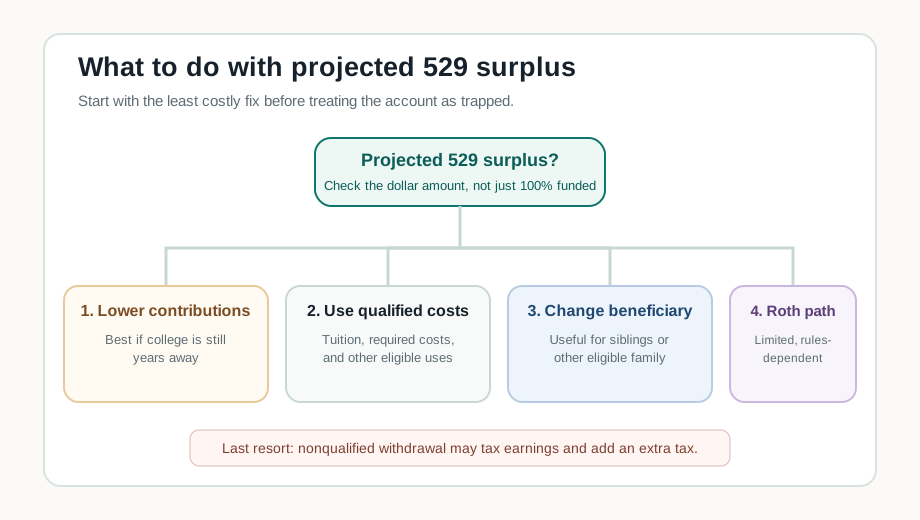
If your 529 looks overfunded, run the choices in this order:
- Lower future contributions if the student is still years from college.
- Use the money for other qualified education expenses for the same beneficiary.
- Change the beneficiary to another eligible family member when that fits the family plan.
- Consider the 529-to-Roth IRA rollover only if the account, beneficiary, contribution, and annual Roth IRA rules fit.
- Treat a nonqualified withdrawal as a last-resort release valve because the earnings portion may be taxable and may face an additional tax.
The 529 rules create options, not a license to overfund blindly.
A Concrete Overfunding Scenario
Assume a family is saving for Avery:
| Input | Assumption |
|---|---|
| Child age | 6 |
| School target | Private college |
| Today's annual cost assumption | $65,000 |
| Family share | 100% |
| Current 529 balance | $40,000 |
| Monthly contribution | $1,600 |
| Investment return assumption | 6% |
| College-cost inflation | 5% |
Under those assumptions, the calculator projects Avery's four-year family cost near $503,000 in future dollars. The account is fully funded and ends college with about $47,000 left over.
Open the prefilled Avery overfunded 529 scenario to start with the assumptions above, then map the child age, school cost, current balance, and monthly contribution to your situation.
That $47,000 surplus is useful information. It means the family can probably lower contributions, keep a smaller cushion, or split future dollars into a more flexible account.
The Contribution Lever
The College Planner solver says this same scenario needs about $1,452 per month to fully fund Avery's plan with almost no leftover balance.
| Monthly contribution | Result | Projected surplus |
|---|---|---|
| $1,452 | Barely fully funded | ~$0 |
| $1,500 | Fully funded with a cushion | ~$15,000 |
| $1,600 | Fully funded with a larger cushion | ~$47,000 |
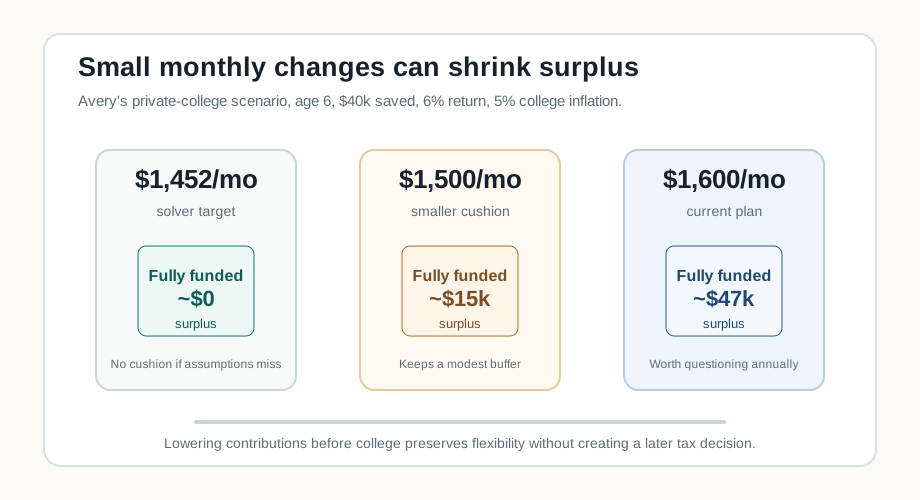
The right answer may not be the lowest number. A cushion can be reasonable because costs, returns, aid, and school choice can change. But a projected $47,000 surplus is a signal to ask whether every extra dollar still belongs in the 529.
What Counts as "Too Much"?
A 529 is not too large just because the funded percentage says 100%. A plan can need a cushion for:
- Higher-than-modeled college inflation.
- A private or out-of-state school instead of the baseline target.
- Graduate school, professional school, or another qualified program.
- A sibling, cousin, or other eligible family member who may use the funds.
- Market returns that come in below the assumed return.
The real overfunding question is this:
If the current plan goes as expected, how much money would be left after all realistic qualified education uses?
If the surplus is small, it may simply be a cushion. If it keeps growing, the next contribution dollar may belong somewhere more flexible.
Option 1: Lower Future Contributions
This is the cleanest fix because it acts before the surplus becomes a tax problem.
In Avery's example, dropping from $1,600 to $1,500 per month still fully funds the modeled goal and reduces projected surplus from about $47,000 to about $15,000. Dropping closer to $1,452 per month nearly eliminates the surplus under the same assumptions.
That freed-up $100 to $148 per month could go to:
- A taxable brokerage account for flexible college extras.
- Retirement savings.
- Emergency reserves.
- A sibling's 529.
- Near-term cash goals that should not be invested.
The important point is that contribution reductions preserve optionality. A nonqualified withdrawal tries to recover optionality later.
Option 2: Use Other Qualified Education Expenses
Qualified 529 uses are broader than tuition alone. The IRS rules for qualified tuition programs cover qualified higher education expenses, and current law also includes certain other education-related uses. The exact treatment can depend on expense type, institution, beneficiary, and timing, so verify current IRS and plan rules before assuming an expense qualifies.
For planning, this means "too much" should be measured after you consider realistic qualified uses, not only after first-year tuition.
Option 3: Change the Beneficiary
If one child does not need the money, the account may be useful for another eligible family member. This can help when:
- A younger sibling has a bigger college gap.
- A student receives a scholarship.
- The beneficiary chooses a lower-cost school.
- A grandparent wants the account to stay in the family education pool.
This is one reason a family with multiple kids should not optimize each 529 in isolation. A surplus for one child can sometimes help cover a gap for another.
Option 4: Consider the 529-to-Roth IRA Rollover Carefully
SECURE 2.0 added a limited way to move certain unused 529 funds to a Roth IRA for the beneficiary. The IRS describes this as subject to requirements, including the 529 account being maintained for at least 15 years, annual Roth IRA contribution limits, and a lifetime rollover limit.
That rollover option is helpful, but it has guardrails:
- It is for the beneficiary, not the parent.
- The account-age and contribution-age rules matter.
- Annual Roth IRA limits still apply.
- The lifetime rollover cap is limited.
- The beneficiary needs eligible compensation for Roth IRA contribution rules to work.
So do not overfund a 529 simply because "Roth rollover" exists. Treat it as a backstop for some surplus, not as the main savings strategy.
Option 5: Nonqualified Withdrawal
If there is no qualified education use, no good beneficiary change, and no Roth rollover path, a nonqualified withdrawal may still be possible. The cost is that the earnings portion may be included in income and may face an additional tax.
That does not mean the account is trapped forever. It means the 529 tax benefit is strongest when the money is actually used for qualified education.
Make the Example Your Own
Start from the article assumptions, then check three outputs:
- Funded percentage: Are you short, fully funded, or far above target?
- Surplus: How many dollars are projected to remain after college?
- Contribution sensitivity: How much surplus disappears if you lower monthly contributions?
Then run three versions:
| Version | What to change | Why |
|---|---|---|
| Current plan | Keep the current contribution | Shows the projected surplus |
| Lower contribution | Reduce by $100-$200/month | Tests whether the plan still works |
| Flexible split | Move extra dollars outside the 529 | Preserves optionality if the goal changes |
If you are still deciding between account types, read 529 Plan vs Taxable Brokerage for College Savings. If you are still setting the monthly target, start with How Much Should You Save for College Each Month?.
Bottom Line
An overfunded 529 is not automatically bad. It becomes a problem when the surplus is large, the family has no realistic qualified education use, and every new contribution keeps increasing a restricted balance.
Use the 529 for the high-confidence education goal. Keep optional dollars flexible. Recheck the surplus every year, especially once the student is close enough to college that the target school, aid picture, and family-share goal are clearer.
Sources
- IRS Topic No. 313, Qualified Tuition Programs
- IRS Publication 970, Tax Benefits for Education
- College Board Trends in College Pricing
Educational content only. This is not individualized financial, tax, legal, investment, or college financial-aid advice.
More 529 College Savings Calculator articles
Practical examples that connect the calculator to real planning decisions.
529 Plan vs Taxable Brokerage for College Savings
Compare a 529 plan vs a taxable brokerage for college savings with a concrete 12-year scenario, tax drag, flexibility tradeoffs, and 529 overfunding risks.
How Much Should You Save for College Each Month?
Use a concrete 529 example to estimate monthly college savings, then test the number against inflation, current savings, and target school type.