Short Answer
Cap rate tells you how the property performs before financing. Cash-on-cash return tells you how your actual invested cash performs after financing.
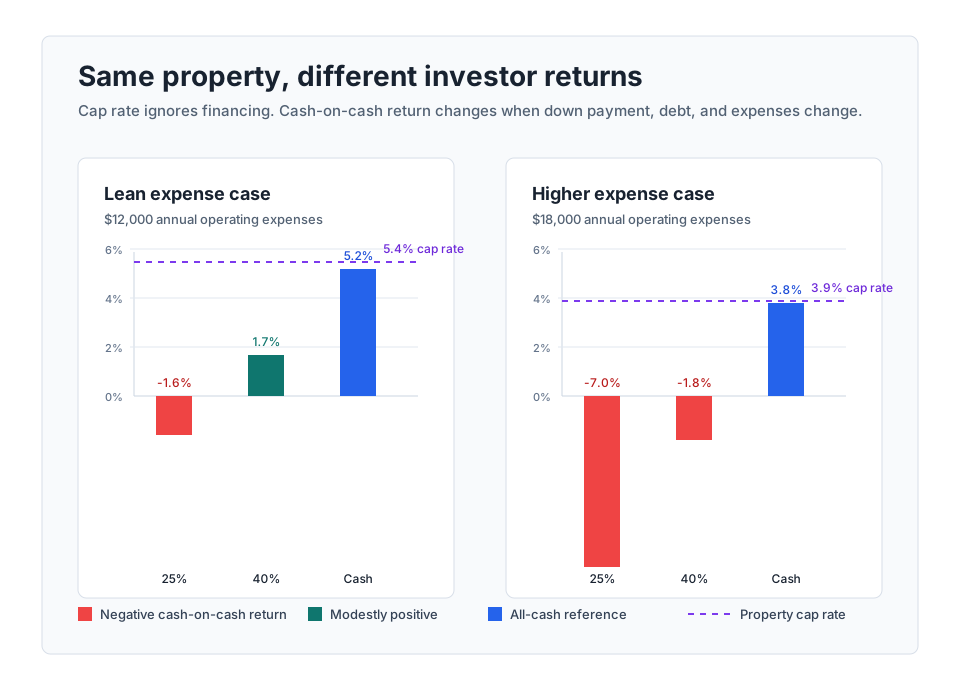
That difference matters because the same rental can have the same cap rate and very different investor outcomes. In the scenario below, a $400,000 duplex has a 5.4% cap rate under a lean expense assumption. With 25% down, the same deal has about -1.6% cash-on-cash return because debt service is higher than the property's first-year net operating income. With 40% down, cash-on-cash turns slightly positive at about 1.7%.
Neither number is the whole decision. Cap rate is useful for comparing properties. Cash-on-cash return is useful for testing your financing, cash flow, and risk.
What Cap Rate Means
Cap rate is short for capitalization rate. It compares a property's annual net operating income with the purchase price:
cap rate = annual net operating income / property priceNet operating income usually means rent after vacancy and operating expenses, before mortgage payments and income taxes. That is why cap rate is a property-level metric. It asks, "How much income does this building produce before I decide how to finance it?"
For a beginner, cap rate is helpful because it strips out your loan choice. Two buyers can use different mortgages, but the building's rent, vacancy, taxes, insurance, repairs, and management costs are still the starting point.
What Cash-on-Cash Return Means
Cash-on-cash return compares the annual cash flow you receive with the cash you put into the deal:
cash-on-cash return = annual pre-tax cash flow / initial cash investedInitial cash usually includes the down payment and buyer closing costs. Annual pre-tax cash flow usually starts with net operating income and then subtracts debt service.
That makes cash-on-cash more personal than cap rate. It changes when your down payment, mortgage rate, closing costs, vacancy, or expense assumptions change.
The Example Scenario
Here is the duplex scenario for this article:
| Input | Scenario |
|---|---|
| Purchase price | $400,000 |
| Gross monthly rent | $3,200 |
| Gross annual rent | $38,400 |
| Vacancy assumption | 5% |
| Property management | 8% of collected rent |
| Mortgage rate | 6.75% fixed |
| Loan term | 30 years |
| Buyer closing costs | 3% of price, or $12,000 |
| Expense test 1 | $12,000 per year |
| Expense test 2 | $18,000 per year |
The expense line is intentionally broad. It can include property taxes, landlord insurance, maintenance, repairs, reserves, HOA dues, owner-paid utilities, and other operating costs. Rental owners should be explicit about those assumptions. The IRS explains that rental income and many ordinary rental expenses are part of the rental-property tax picture, while depreciation and other rules can affect taxable income separately from cash flow in Topic No. 414 and Publication 527.
Vacancy should also be explicit. The Census Bureau tracks rental vacancy rates nationally through its Housing Vacancies and Homeownership data, which is a useful reminder that rent is not the same as collected rent.
Open the prefilled duplex cap-rate and cash-on-cash scenario to start with the duplex price, rent, vacancy, management, financing, and lean expense assumptions above, then map the deal to your situation.
Step 1: Calculate The Cap Rate
With $3,200 of monthly rent, the property has $38,400 of annual gross rent.
After 5% vacancy, collected rent is:
$38,400 x 95% = $36,480After an 8% management fee, management costs are about:
$36,480 x 8% = $2,918Under the lean $12,000 expense assumption:
net operating income = $36,480 - $2,918 - $12,000 = $21,562
cap rate = $21,562 / $400,000 = 5.4%
Under the heavier $18,000 expense assumption:
net operating income = $36,480 - $2,918 - $18,000 = $15,562
cap rate = $15,562 / $400,000 = 3.9%
The property did not change. The expense assumption changed. That is one reason cap rate should never be accepted without checking what expenses are included.
Step 2: Calculate Cash-on-Cash Return
Now add financing.
With 25% down, the buyer puts down $100,000 and pays about $12,000 of closing costs, for $112,000 of initial cash. A $300,000 mortgage at 6.75% for 30 years has principal and interest of about $23,350 per year.
Under the lean expense case:
annual pre-tax cash flow = $21,562 - $23,350 = -$1,788
cash-on-cash return = -$1,788 / $112,000 = -1.6%
That same 5.4% cap-rate property is still negative on first-year cash-on-cash return with 25% down.
If the buyer instead puts 40% down, debt service drops because the loan is smaller. Initial cash rises to $172,000, but annual pre-tax cash flow improves to about $2,882:
cash-on-cash return = $2,882 / $172,000 = 1.7%Same property. Same rent. Same cap rate. Different financing. Different cash-on-cash return.
What The Two Numbers Show
| Scenario | Cap rate | Annual cash flow | Initial cash | Cash-on-cash return |
|---|---|---|---|---|
| Lean expenses, 25% down | 5.4% | -$1,788 | $112,000 | -1.6% |
| Lean expenses, 40% down | 5.4% | $2,882 | $172,000 | 1.7% |
| Lean expenses, all cash | 5.4% | $21,562 | $412,000 | 5.2% |
| Higher expenses, 25% down | 3.9% | -$7,788 | $112,000 | -7.0% |
| Higher expenses, 40% down | 3.9% | -$3,118 | $172,000 | -1.8% |
| Higher expenses, all cash | 3.9% | $15,562 | $412,000 | 3.8% |
The table gives the beginner lesson:
- Cap rate is cleaner for property comparison. It tells you whether the rent and operating expense assumptions are strong before debt.
- Cash-on-cash return is closer to your bank account. It tells you whether your actual financing creates cash flow or a monthly shortfall.
- Leverage cuts both ways. A smaller down payment can improve return when the spread is favorable, but it can also make a modest cap-rate property cash-flow negative.
- Expense optimism can flip the deal. The 25% down scenario moves from a small annual shortfall to a much larger one when expenses are $6,000 higher.
Which Number Should You Trust?
Use both, but for different questions.
Use cap rate when you are asking:
- Is this property productive before financing?
- Are the rent and expense assumptions realistic?
- How does this listing compare with another listing?
- Is the seller's pro forma hiding expenses?
Use cash-on-cash return when you are asking:
- What happens with my actual down payment?
- Can I handle the monthly cash flow?
- Does the loan quote make the deal work or break it?
- Would I rather invest the same cash somewhere else?
Mortgage terms deserve special attention. The CFPB's guide to comparing Loan Estimates emphasizes comparing upfront costs, monthly payment, and the five-year cost of borrowing. For an investment property, those loan details flow directly into cash-on-cash return.
Common Mistakes
Mistake 1: Comparing cash-on-cash returns across different financing assumptions. A deal with 15% down and a deal with 40% down are not automatically comparable. The lower-down-payment version may show a higher or lower cash-on-cash return because leverage changed.
Mistake 2: Treating cap rate as monthly affordability. A property can have a reasonable cap rate and still be cash-flow negative after debt service.
Mistake 3: Ignoring vacancy and management. Gross rent is not collected rent. A property that works only at 0% vacancy and no management fee deserves a stress test.
Mistake 4: Leaving taxes out of the conversation entirely. This article uses pre-tax cash flow so the core math is easy to see. Real owners may also need to consider rental income, deductible expenses, depreciation, passive activity limits, and future recapture. Those rules are not the same as cash in the bank.
Make the Example Your Own
Start from the $400,000 duplex scenario, then test three versions:
- Increase annual operating expenses from $12,000 toward $18,000 and watch the cap rate fall.
- Compare 25% down, 40% down, and all cash so cash-on-cash is tied to a real financing choice.
- Change the mortgage rate from 6.75% to the rate on your actual loan estimate.
Then ask one practical question: what assumption has to go right for this deal to feel good?
If the answer is "everything," the cap rate is not enough. If the answer is "rent can be a little lower and expenses can be a little higher, and I still have cash-flow room," the property is more resilient.
Related
- How Much Rent Do You Need for a Rental Property to Break Even?
- Is a Rental Property a Good Investment?
Sources
- IRS Topic No. 414: Rental Income and Expenses
- IRS Publication 527: Residential Rental Property
- U.S. Census Bureau: Housing Vacancies and Homeownership
- Consumer Financial Protection Bureau: Compare Loan Estimates
This article is educational, not personalized investment, tax, or legal advice. Use the calculator to understand the moving parts, then confirm deal-specific assumptions with qualified real estate, lending, tax, and legal professionals.
More Investment Property Calculator articles
Practical examples that connect the calculator to real planning decisions.
Is a Rental Property a Good Investment? Compare Cash Flow, Appreciation, and Stocks
Compare a rental-property scenario against stocks using monthly cash flow, appreciation, sale proceeds, and total return.
How Much Rent Do You Need for a Rental Property to Break Even?
Learn how to estimate the rent a rental property needs to break even after vacancy, management, mortgage payments, and operating expenses.