Short Answer
A career test result is a clue, not a command. Use it to notice patterns, then rebuild the question around your actual launch situation: where you are now, your study path, what evidence you have, what you want from work, what you dislike, and how hard the entry gate is.
That is the job of the Career Path Advisor. It is not trying to tell you who you are. It ranks starter career paths by fit for your situation and by the gates between you and the first real step.
Why Old Career Quiz Results Can Feel Wrong
Many career tests are built around interests. Interest matters. The O*NET Interest Profiler, for example, helps people identify broad work-interest areas and use them to explore occupations.
The problem is that early-career decisions are not only interest decisions.
A freshman comparing majors, a senior in mechanical engineering, a recent biology graduate, and a post-high-school student choosing between paid training and community college need different questions. If the same generic quiz gives each person a list of job titles, the answer may look confident while ignoring the strongest evidence.
The strongest early-career signals often include:
- Your stage: college, post-high-school, recent graduate, or working pivot.
- Your major or training track.
- Your specific concentration, not just the broad field.
- Your academic record where it affects selective gates.
- Your internships, clinical exposure, projects, portfolio, work experience, or certifications.
- Your income timeline and school budget.
- The work style you want and the work style you want to avoid.
The New Question: Which Path Should I Try First?
The Career Path Advisor is built around a more practical question:
Given what I have already studied or done, which starter career paths are most worth trying first?
That is different from "What career matches my personality?"
For example, "studied engineering" should be strong evidence for engineering, engineering technician, manufacturing, operations, energy, construction, data, product, and technical sales paths. It should not be treated as just another vague interest next to "work-life balance."
Likewise, "business / finance" should split into finance, accounting, analytics, marketing, management, and supply chain. "Health / life science" should split into nursing, pre-med, physician assistant, dental, pharmacy, therapy, biology or health science, public health, kinesiology, allied health, and health administration. A specific track should move the ranking because it changes both fit and entry odds.
Example: Same Quiz Result, Different Ranking
Maya and Jordan both take a career test and both score high on investigative interests. A generic quiz might push both toward "science" or "research."
Their launch evidence is different.
| Signal | Maya | Jordan |
|---|---|---|
| Stage | College senior | Recent high-school graduate |
| Study | Biology / health science | No college yet |
| Strengths | Detail work, lab classes, patient communication | Hands-on repair, reliability, physical work |
| Launch evidence | Lab course, volunteer clinic, strong grades | Part-time work, shop class, wants income soon |
| Constraints | Open to two more years if payoff is clear | Needs paid or low-debt training |
Maya might compare lab/research associate, allied health tech, public health, nursing, pre-med or other health professional tracks, and healthcare operations.
Jordan might compare electrician, HVAC, automotive/diesel, manufacturing technician, emergency medical technician, warehouse/logistics, and community-college health tech routes.
The interest pattern helped, but the launch situation changed the shortlist.
How to Fill Out the Career Path Advisor
Use the advisor like an evidence board.
| Profile area | What to enter | Why it matters |
|---|---|---|
| Your goals | Pay, security, enjoyment, work-life balance, fast earning, helping people, climbing, creativity | Goals explain what the path needs to do for your life |
| Your strengths | People, technical, numbers, hands-on, writing, teaching, selling, academic record | Strengths affect both fit and first-job odds |
| Study path | Broad field plus major, concentration, or training track | Specific study evidence should move direct paths up |
| Launch evidence | Internship, clinical exposure, projects, portfolio, work experience, certifications | Evidence separates "sounds good" from "can start" |
| Day-to-day likes | Desk, field, people-facing, team, independent, routine, variety, regular hours | The hours of the job matter more than the title |
| Dislikes | Sales pressure, heavy desk work, blood, irregular hours, long training, high debt | Strong dislikes should push down bad daily fits |
| About you | Stage, education, GPA where relevant, income timeline, school budget | A path can fit but still be too slow, expensive, or selective |
| Fields that pull you | Categories you are open to | Useful when you want to compare within a domain |
The more concrete your evidence, the more meaningful the ranking becomes.
How to Read Fit Versus Entry Odds
A high-fit path is not always an easy-entry path.
Fit asks: would this path use your goals, strengths, interests, and work preferences?
Entry odds ask: given your stage, study, grades, evidence, training budget, and timeline, how realistic is the first step?
That distinction prevents two common mistakes:
- Over-recommending prestige paths when the gate is not realistic right now.
- Over-recommending easy-entry jobs when the person has strong major evidence for a more direct professional path.
Read the top results in three groups.
| Result type | What it means | What to do |
|---|---|---|
| High fit, strong odds | Worth researching immediately | Compare real postings, pay, training, and people in the field |
| High fit, weaker odds | Possible stretch | Identify the missing gate: GPA, portfolio, certification, internship, license, or program seat |
| Lower fit, strong odds | Practical backup | Keep it as a fallback, but do not let convenience overrule better evidence |
What to Do When a Result Looks Wrong
Do not just reject a strange result. Diagnose it.
Ask five questions:
- Which input lifted this path?
- Is that input really important, or did I over-select it?
- Did I enter a broad field but skip the specific major dropdown?
- Did I leave out launch evidence like internships, projects, clinical exposure, work experience, or certifications?
- Is the result strong because it is practical, or because it actually fits?
If you studied engineering and a generic office role ranks above engineering-adjacent paths, check whether you selected the specific engineering major or track. If you studied accounting and finance roles are not moving, check whether the business concentration is set. If you want healthcare but direct patient care is not for you, compare allied health tech, lab, health information, public health, and healthcare operations instead of treating healthcare as one path.
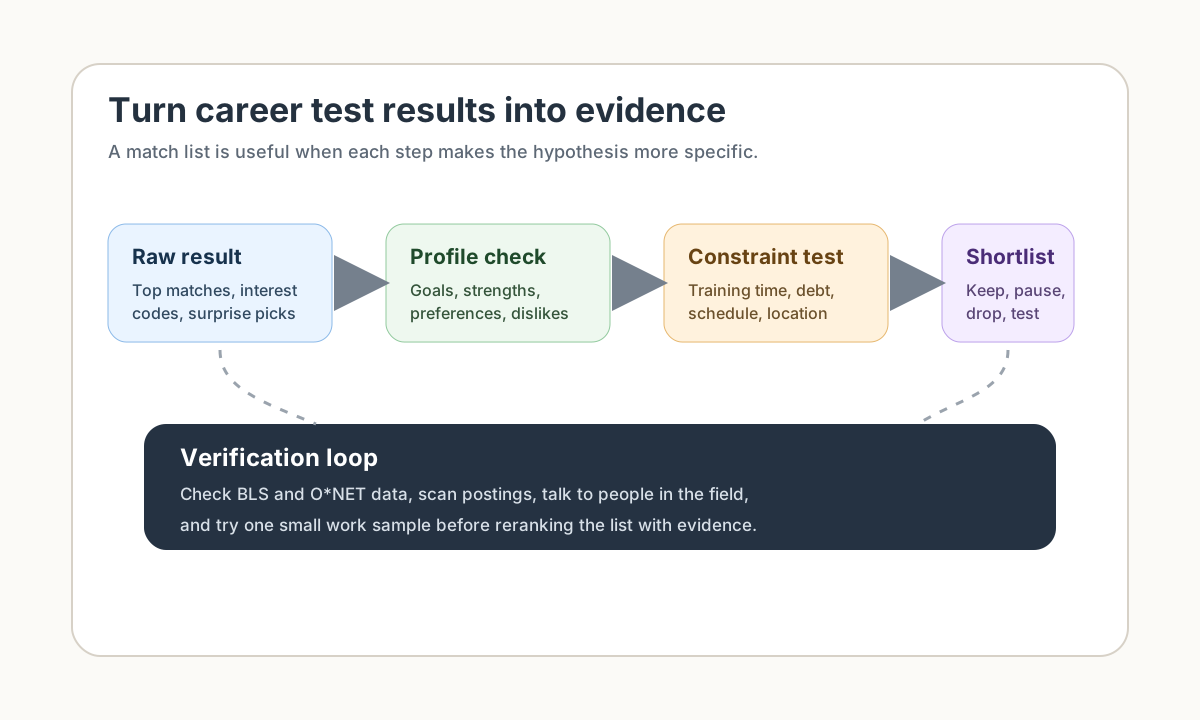
Verify the Shortlist With Outside Data
The advisor builds a shortlist. It does not replace research.
For each serious path, check:
| Question | Where to verify |
|---|---|
| What do people actually do? | BLS Occupational Outlook Handbook and O*NET OnLine |
| What education, training, license, or portfolio is typical? | BLS, O*NET, state licensing boards, program websites, employer postings |
| What is entry-level pay, not just median pay? | Job postings, BLS wage data, school outcome reports |
| Is the field growing, stable, shrinking, or being reshaped by AI? | BLS outlook, industry sources, employer demand |
| What does entry really require? | Internship postings, alumni pages, LinkedIn profiles, program prerequisites |
The BLS Occupation Finder is useful for comparing education, pay, projected growth, and training across occupations. O*NET OnLine is useful when you want detailed tasks, tools, work activities, interests, work values, and work context.
Run Small Tests Before Big Commitments
The right output is not "I found my career." It is a shorter, better test list.
Try a two-week evidence sprint:
| Day range | Test |
|---|---|
| Days 1-2 | Read BLS and O*NET pages for your top five paths |
| Days 3-4 | Scan 20 entry-level postings and list repeated requirements |
| Days 5-6 | Compare two programs, certificates, apprenticeships, or major tracks |
| Days 7-9 | Talk to two people in or near the field |
| Days 10-12 | Try a small work sample: spreadsheet model, CAD tutorial, patient-care shadow, coding task, lesson plan, case note, sales script, or lab-style writeup |
| Days 13-14 | Re-rank: keep, pause, drop, or investigate an adjacent path |
This is especially important before expensive school decisions. A path can be attractive and still be the wrong next move if the gate is too long, too expensive, or too fragile.
When to Use the High-School Advisor Instead
If you are still choosing broad directions, use the High School Career Direction Advisor first. It is built for questions like:
- What major families should I consider?
- Which subjects point toward which paths?
- Does this path look realistic with my current school runway?
- Which broad directions should I test before choosing classes or colleges?
Use the Career Path Advisor when the question is more concrete:
- I have a major or training field.
- I need a first serious job path.
- I am comparing certificate, degree, apprenticeship, or portfolio routes.
- I need to know which starter career paths are practical now.
Common Mistakes
- Treating the highest score as a verdict.
- Treating a broad major as enough evidence when the concentration matters.
- Ignoring GPA or program selectivity for grade-gated paths.
- Ignoring internships, projects, clinical exposure, portfolio work, or certifications.
- Choosing the fastest-paycheck path when a better-fit path is within reach.
- Choosing the highest-income path without checking debt, training time, schedule, and entry odds.
- Reading "weak fit" as personal failure instead of model feedback from the current inputs.
Make the Example Your Own
Build a first profile, then run three changes:
- Add the most specific major or training track you can.
- Add real launch evidence: internship, project, clinical exposure, certification, portfolio, or work experience.
- Change one constraint at a time, such as income timeline, school budget, or regular-hours preference.
Watch which paths stay strong. Those are the ones to verify first.
Related: How to Choose a Career Direction in High School
Sources
- BLS Occupational Outlook Handbook
- BLS Occupation Finder
- O*NET OnLine
- O*NET Career Exploration Tools
- O*NET Interest Profiler
- NCES: College Majors and Careers
This article is educational career-planning content. It is not career counseling, academic advising, employment advice, or a promise that a specific occupation will be right for a specific person.
Run the scenario yourself
Open the calculator, adjust the assumptions, and compare the result to the article.